
There is a distinct, unsettling quality to an empty parking garage after hours. These cavernous, concrete subterranean structures serve as modern architectural paradoxes: built specifically to house hundreds of people and vehicles during the day, yet utterly desolate and eerie once night falls. When the bustling commuters vanish, harsh industrial luminaires take over, casting long, angular shadows across oil-stained slabs and brutalist pillars. The silence is visceral, broken only by the intermittent hum of high-voltage transformers, the rhythmic drip of drainage pipes, or the distant shudder of an automated ventilation fan. Capturing this suspenseful, neo-noir ambiance demands intentional camera craft, disciplined exposure control, and an understanding of psychological tension.
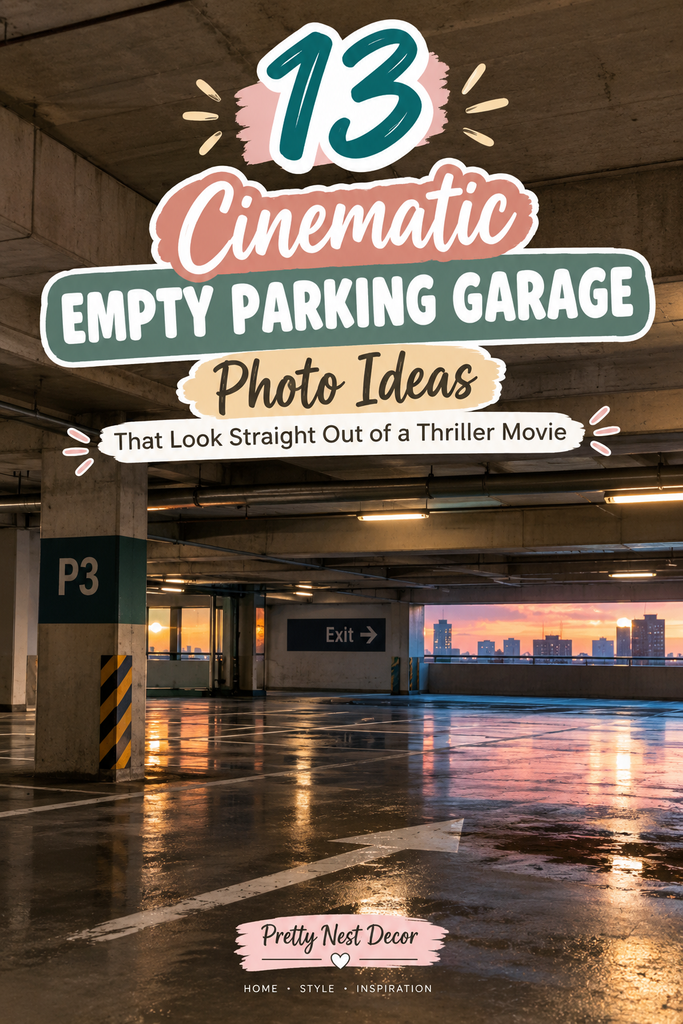
Transforming an everyday municipal parkade into a frame worthy of a high-budget psychological thriller requires treating concrete, steel, and shadow as active narrative characters. Rather than shooting haphazard wide angles, cinematic photography isolates geometry, leans into sickly fluorescent color grading, and embraces negative space. Below is an exhaustive, deep-dive guide to 13 fresh, high-tension empty parking garage concepts designed to evoke visceral suspense, cinematic claustrophobia, and mystery.
The Anatomy of Subterranean Suspense: Lighting, Geometry, and Texture
Suspense in still photography relies on what remains concealed just as much as what is revealed. Underground and multi-deck parking garages naturally provide the visual building blocks of classic thriller cinematography:
- Monolithic Brutalism: Massive poured-concrete pillars, exposed load-bearing beams, and low-profile ceilings compress vertical space, instilling instant subconscious claustrophobia.
- Repetitive Linear Perspective: Painted stall dividers, yellow directional arrows, overhead cable conduits, and sprinkler mains form aggressive vanishing points that pull the viewer’s eye toward dark, unmapped thresholds.
- Industrial Color Temperatures: The clash between sickly cool cyan-green fluorescent tubes (4000K–5000K) and dirty sodium-vapor amber fixtures (2200K) creates natural chromatic friction, eliminating cozy warmth and replacing it with sterile dread.
- Surface Grime and Textural Decay: Decades of exhaust soot, grease pools, rubber skid burns, hairline structural fractures, and calcified water seepage lend authentic tactile realism to every surface.
Mastering these environmental elements turns concrete parking decks into evocative visual stages ready for cinematic storytelling.
Camera Settings, Optics, and Gear for Low-Light Tension
Achieving clean, movie-grade frames in low-light industrial environments without washing out dark shadows requires deliberate gear choices:
- Focal Lengths: Wide-angle lenses (20mm to 28mm) exaggerate linear distance, making endless bays feel unnervingly infinite. Conversely, moderate telephotos (70mm to 85mm) compress concrete pillars together, creating an optical wall of brutalist pylons that feels suffocating.
- Aperture Control: Shoot between $f/4$ and $f/8$ on a stable tripod whenever capturing structural geometry to keep both foreground pavement grime and distant exit thresholds razor-sharp. When isolating single narrative props, open up to $f/1.8$ or $f/2.8$ to drop the background into ominous, bokeh-softened obscurity.
- Exposure Strategy: Underexpose your meter by $-0.7$ to $-1.3$ EV. Modern digital sensors have vast dynamic range in the shadows, but overexposing washes out the mood, turning deep, foreboding blacks into milky gray noise.
- Atmospheric Practical Tools: Pack a handheld pocket haze machine or canned atmosphere mist. A light mist suspended beneath low garage ceilings catches overhead fluorescent beams, creating volumetric light shafts that look straight out of 35mm motion picture stock.
1. The Endless Symmetrical Vanishing Corridor
Visual Premise
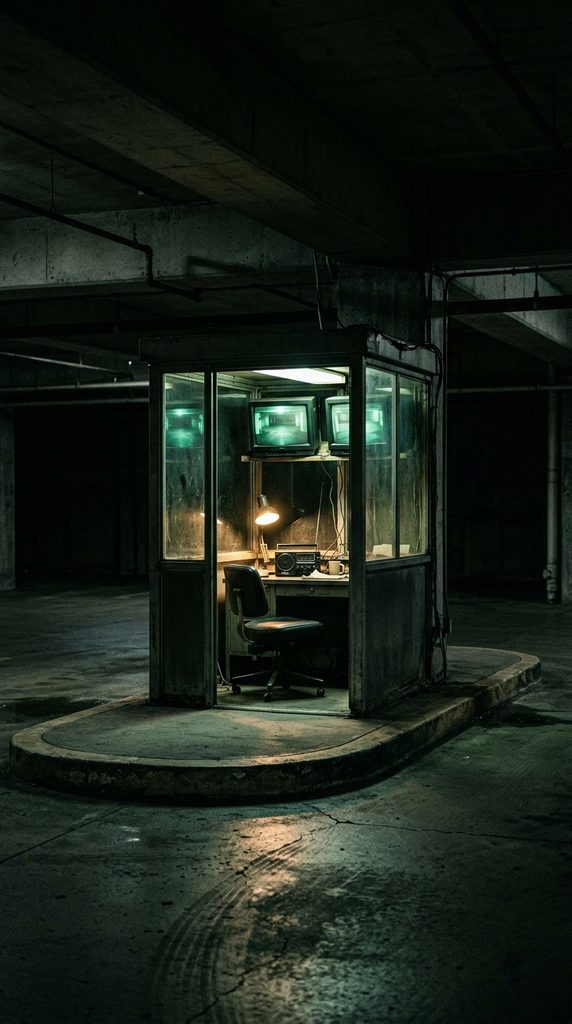
A dead-center, one-point perspective gaze down a seemingly infinite driving lane flanked by identical load-bearing concrete pillars. The ceiling is crisscrossed with conduit pipes and sprinkler mains, while the roadway ahead terminates in an impenetrable, pitch-black void where the light fixtures simply end.
Narrative Atmosphere
This concept evokes the cold, geometric dread of an endless corporate labyrinth. It suggests entrapment—a protagonist realizing that every floor looks identical and every corridor leads further into the unknown. The camera position reinforces isolation by placing the viewer in the exact center of an empty expanse, stripped of any cover or escape route.
Lighting and Set Dressing
- Key Lighting: An overhead row of recessed fluorescent fixtures running down the central driving aisle. Allow every third or fourth tube to be dead or flickering to break up the rhythm organically.
- Color Palette: Sallow institutional cyan-green overhead, shifting into pure, crushing obsidian black at the far vanishing point.
- Floor Texture: Freshly washed or damp concrete with faint, worn yellow directional arrows pointing directly away from the lens toward the dark terminus.
Technical Camera Execution
- Focal Length: 24mm ultra-wide.
- Camera Height: Low-level, exactly 45 cm (18 inches) above the tarmac, perfectly centered between the left and right pillar rows.
- Settings: $f/8$, ISO 200, 1.5-second exposure on a tripod.
- Composition: Strict symmetrical framing. Ensure vertical pillar lines remain square with the frame edges without tilting keystones.
2. The Isolated Security Station Glass Cubicle
Visual Premise
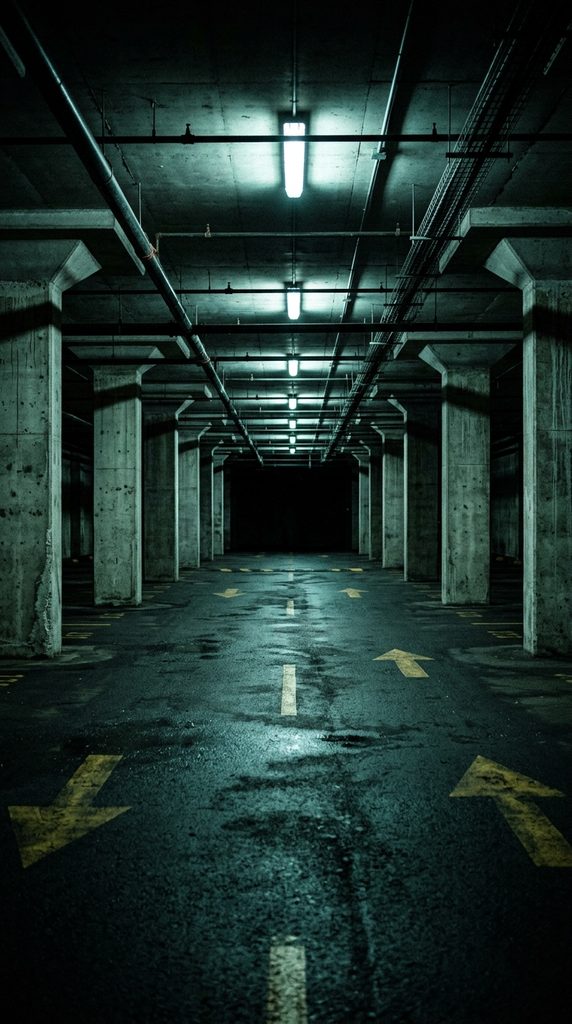
A solitary, raised glass security booth perched on a concrete island in an otherwise vacant, pitch-black basement level. The interior of the booth is illuminated by glowing green monitor banks and a single overhead desk lamp, yet the chair is empty, an unclipped radio sits on the console, and a cracked coffee mug rests beside an open logbook.
Narrative Atmosphere
An abandoned guard post signals that whatever security or safety existed in this facility has broken down. It triggers instant questions: Where did the guard go? What appeared on the surveillance monitors right before they abandoned their post? The contrast between warm interior technology and the cavernous, unlit parking perimeter heightens vulnerability.
Lighting and Set Dressing
- Key Lighting: Internal glow emanating entirely from within the glass booth—cool monitor blue balanced against a warm amber desk lamp.
- Ambient Lighting: Complete shadow on the surrounding garage floor, with only faint, specular reflections of the booth windows skimming across oily puddles on the pavement.
- Props: An overturned office chair, a flickering green CRT monitor displaying static, and an open spiral-bound daily visitor log.
Technical Camera Execution
- Focal Length: 50mm standard prime.
- Camera Height: Eye level, 160 cm, shot through the gap between two foreground pillars to create a voyeuristic, surveillance-style frame.
- Settings: $f/2.8$, ISO 400, 1/15s handheld or locked on a tripod.
- Composition: Place the glowing booth in the right-third intersection, allowing deep, textured black space to dominate the left two-thirds.
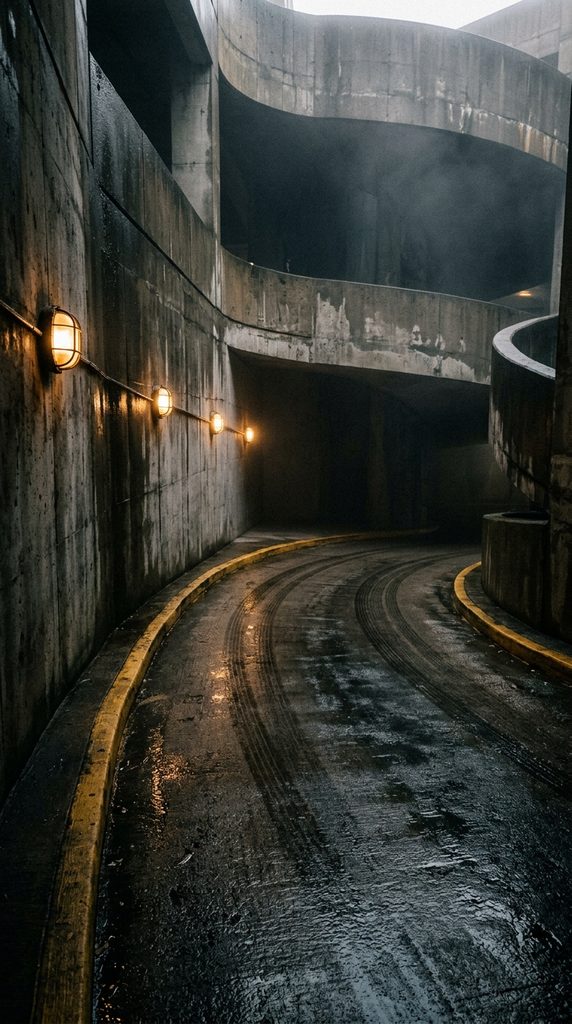
3. The Damp Spiral Helical Exit Ramp
Visual Premise
A high-angle or low-angle look along a continuous, descending concrete helical spiral ramp. Water seepage from recent street rain has collected in the banked curve, creating a slick, dark surface that catches the harsh reflections of low-mounted amber wall sconces.
Narrative Atmosphere
Helical structures represent psychological descent and vertigo. In a thriller context, the spiral ramp is a trap: vehicle headlights cannot see around the tight curve, footsteps echo unpredictably off the curved concrete retaining wall, and the continuous downward gradient symbolizes falling deeper into danger.
Lighting and Set Dressing
- Key Lighting: Low-mounted circular amber bulkhead fixtures affixed to the outer curved concrete wall at regular intervals, casting sweeping scallop patterns of light across the deck.
- Texture Details: Heavy dark tire scrub marks gouged along the outer concrete retaining wall, yellow speed-bump ridges, and pooled standing water reflecting curved overhead stripes.
- Atmosphere: Light condensation or water droplets hanging along the unpainted ceiling slab.
Technical Camera Execution
- Focal Length: 16mm–20mm wide-angle lens.
- Camera Height: Positioned at the apex of the curve, pointing downward along the sweep of the ramp.
- Settings: $f/5.6$, ISO 100, 3-second long exposure to smooth water reflections and deepen shadow contrast.
- Composition: Use the sweeping S-curve or spiral arc of the concrete curb as a leading line cutting diagonally from bottom corner to upper corner.
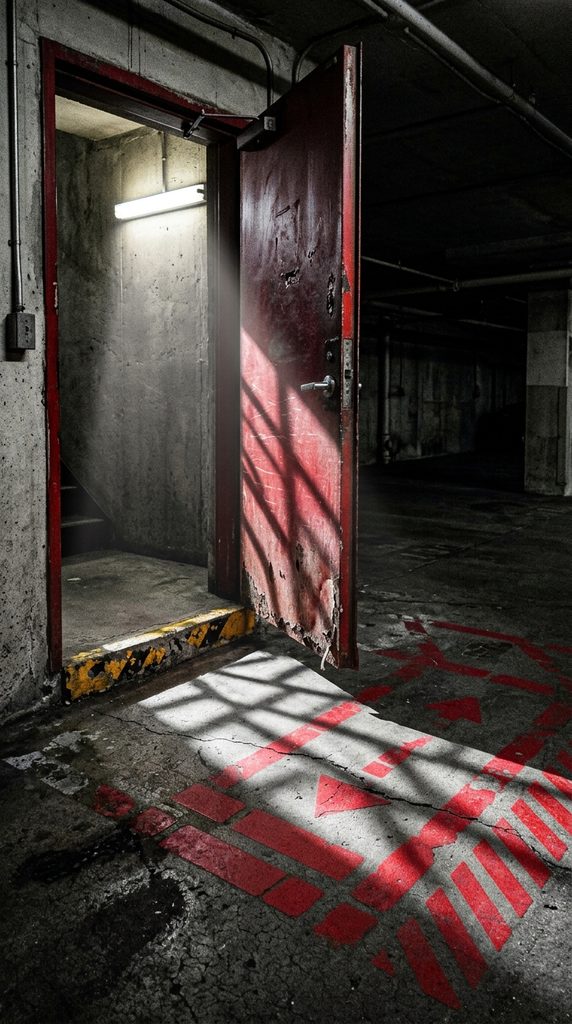
4. The Flickering Subterranean Stairwell Vault
Visual Premise
A heavy, industrial fire door pushed slightly ajar, revealing a narrow, institutional concrete stairwell illuminated by a violent, strobe-like fluorescent tube. Harsh yellow hazard paint stripes border the threshold, while a long, cast shadow falls from the cracked door onto the textured garage floor.
Narrative Atmosphere
Stairwells in multi-level garages are claustrophobic chokepoints. They represent the only alternative when elevators are disabled, yet they offer zero sightlines around tight landings. The cracked door invites suspense: did someone just slip through, or is someone standing quietly behind the heavy metal slab waiting for footsteps to approach?
Lighting and Set Dressing
- Key Lighting: A single flickering fluorescent ballast inside the stairwell casting intermittent, harsh white light through the door seam.
- Shadow Play: A hard, elongated rectangular beam of light cutting through the pitch-black foreground, projecting the silhouette of the door frame across the pavement.
- Props: Red stenciled floor numbering (“LEVEL B3 – NO EXIT”), a rusted panic-bar handle, and peeling institutional green enamel paint along the door frame.
Technical Camera Execution
- Focal Length: 35mm documentary prime.
- Camera Height: Knee level, 60 cm, tilted slightly upward toward the heavy door latch.
- Settings: $f/4$, ISO 800, 1/60s to capture a crisp moment during the fluorescent light’s rapid flicker cycle.
- Composition: Framing the cracked door within the vertical shadows of massive external structural columns.
5. The Solitary Fluorescent Island in Black Space
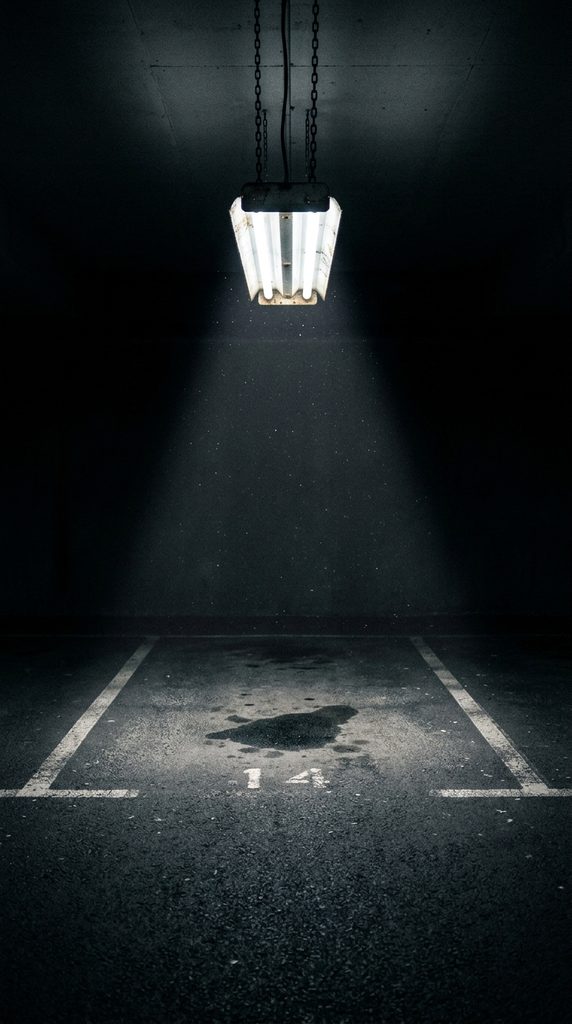
Visual Premise
A single, isolated twin-tube fluorescent light fixture hanging from chains above a lone parking stall in a cavernous, completely unlit garage level. Directly beneath the fixture is a pristine pool of stark white illumination; everything beyond a three-meter radius falls off sharply into absolute, impenetrable blackness.
Narrative Atmosphere
This is the quintessential interrogation-style frame. It strips the environment down to pure minimalist tension. An isolated island of light surrounded by infinite dark represents extreme exposure—stepping into the light makes you visible to everything lurking in the shadows, while staying in the shadows leaves you blind.
Lighting and Set Dressing
- Key Lighting: An overhead industrial shop light fitted with two 6500K daylight tubes, fitted with a narrow aluminum reflector hood to restrict lateral light spill.
- Ground Texture: A single painted white parking stall outline on dark bitumen, with a solitary dark circular oil stain precisely centered beneath the light fixture.
- Atmosphere: Subtle airborne dust motes or a light aerosol mist drifting slowly through the conical downward light beam.
Technical Camera Execution
- Focal Length: 85mm portrait telephoto.
- Camera Height: Chest height, 130 cm, shooting from deep within the unlit darkness toward the illuminated stall.
- Settings: $f/2.8$, ISO 100, 1/30s.
- Composition: Isolate the illuminated rectangular stall dead-center, surrounding it with an unbroken border of deep, unclipped negative black space.
6. The Low-Angle Tire-Tread Pavement Grid
Visual Premise
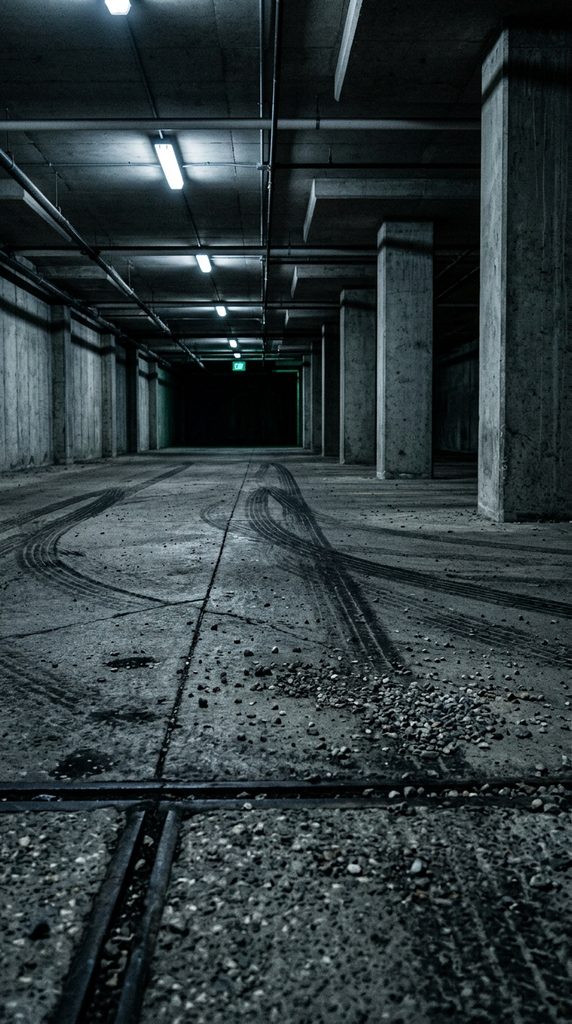
The camera rests directly on the rough, aggregate concrete floor, tilted slightly upward. In the immediate foreground, deep black rubber tire tracks and cracked expansion joints fill the frame, while in the mid-ground, a rhythmic row of massive square support piers recedes toward a distant, faintly glowing green exit sign.
Narrative Atmosphere
Ground-level perspectives immediately convey a sense of vulnerability, evasion, or collapse. This is the vantage point of someone hiding beneath a vehicle, crawling across the deck to stay below sightlines, or watching silently as footsteps approach in the distance. The ceiling feels impossibly heavy, crushing the frame from above.
Lighting and Set Dressing
- Key Lighting: Ambient, low-intensity overhead strip lighting, balanced to skim across the tops of the expansion joints and emphasize the rough, pebble-filled surface texture of the poured concrete floor.
- Color Palette: Cold, slate-gray pavement tones contrasting with a distant, vivid emerald-green exit luminaire.
- Surface Details: Embedded metal drainage grates, scattered pea gravel, cracked concrete expansion joint sealant, and wet tire tracks.
Technical Camera Execution
- Focal Length: 20mm ultra-wide.
- Camera Height: Ground level—camera base plate resting directly on the concrete deck or supported by a beanbag.
- Settings: $f/11$, ISO 100, 4-second exposure on a sturdy tripod.
- Composition: Focus set to the hyperfocal distance so that the abrasive pavement texture 30 cm in front of the lens remains as sharp as the distant piers.
7. The Desolate Elevator Bank with Ajar Doors
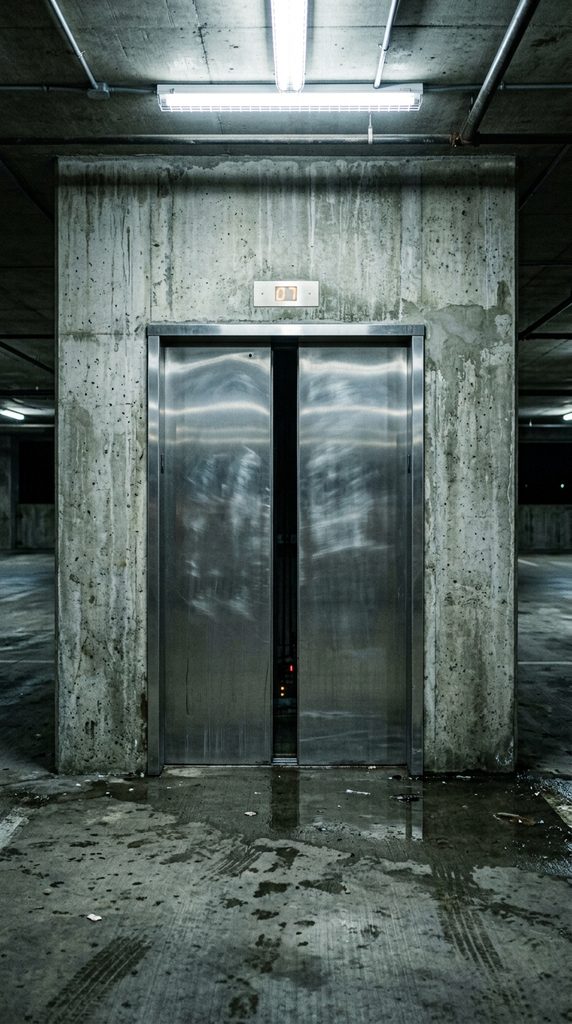
Visual Premise
A pair of stainless-steel elevator doors set into a raw concrete wall at the end of a deserted parking floor. The elevator call indicator displays a glowing red arrow pointing downward, and one of the brushed-steel doors is jammed open by three inches, revealing a dark elevator shaft illuminated only by a faint amber maintenance beacon far below.
Narrative Atmosphere
Elevators in thrillers represent false hope and mechanical traps. An open door into a dark shaft hints at sabotage, structural failure, or an unnatural ambush. The clinical, reflective steel doors contrast against the brutalist concrete surrounding them, reinforcing a sterile, uncaring architectural environment.
Lighting and Set Dressing
- Key Lighting: The warm amber glow seeping up from the interior of the jammed elevator shaft seam, contrasted against the flat, overhead cold-white fluorescent ceiling fixture mounted above the waiting area.
- Reflections: Brushed steel elevator door panels catching warped, distorted reflections of the empty garage deck behind the camera.
- Props: Scratched directional signage, an illuminated call button glowing red, and an abandoned keycard lanyard lying on the floor before the door.
Technical Camera Execution
- Focal Length: 35mm wide-normal prime.
- Camera Height: 110 cm (torso level), aligned straight-on with the elevator door seam.
- Settings: $f/4$, ISO 400, 1/20s.
- Composition: Symmetrical framing of the elevator portal, using the vertical lines of the door frame to divide the frame with mathematical precision.
8. The Blinding Vehicle Headlight Silhouette
Visual Premise
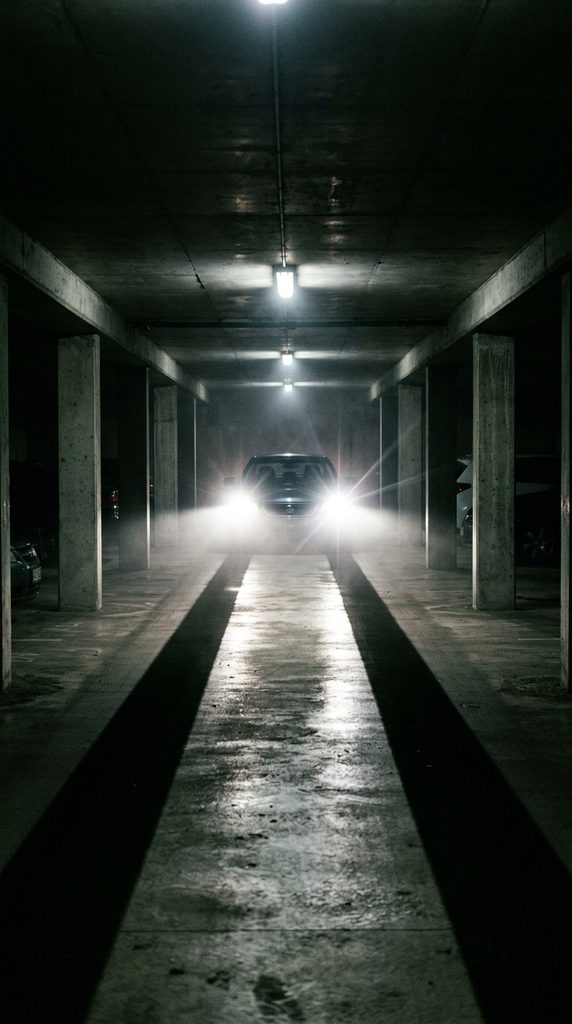
A long-distance, high-tension shot looking down an aisle into the blinding, diffuse twin high-beams of an idling, unidentifiable vehicle parked across two bays in the distance. The light cuts through ambient underground exhaust haze, casting long, razor-sharp shadows from concrete columns directly toward the camera.
Narrative Atmosphere
This is the classic thriller standoff moment. A running vehicle waiting silently in an empty garage represents an unseen adversary. You cannot see who is behind the windshield due to the glare, but the idling high-beams prove they are watching. The viewer is caught entirely in the spotlight, stripped of anonymity.
Lighting and Set Dressing
- Key Lighting: Two intensely bright warm-white automotive LED or halogen headlights aimed straight down the camera axis, intentionally blowing out the center of the frame into a radiant lens flare.
- Volumetric Atmosphere: Dense atmospheric haze or car exhaust smoke drifting across the beams, catching the light shafts with three-dimensional volume.
- Shadows: Hard, elongated shadows cast by structural columns stretching forward toward the lens across wet asphalt.
Technical Camera Execution
- Focal Length: 70mm–100mm telephoto to compress the distance between the vehicle and the foreground columns.
- Camera Height: 90 cm (headlight level).
- Settings: $f/8$, ISO 200, 1/125s to control extreme highlight blowout while preserving deep edge shadows.
- Composition: Place the vehicle headlights slightly off-center to allow long column shadows to sweep diagonally across the pavement.
9. The Industrial Overhead Conduit & Pipe Labyrinth
Visual Premise
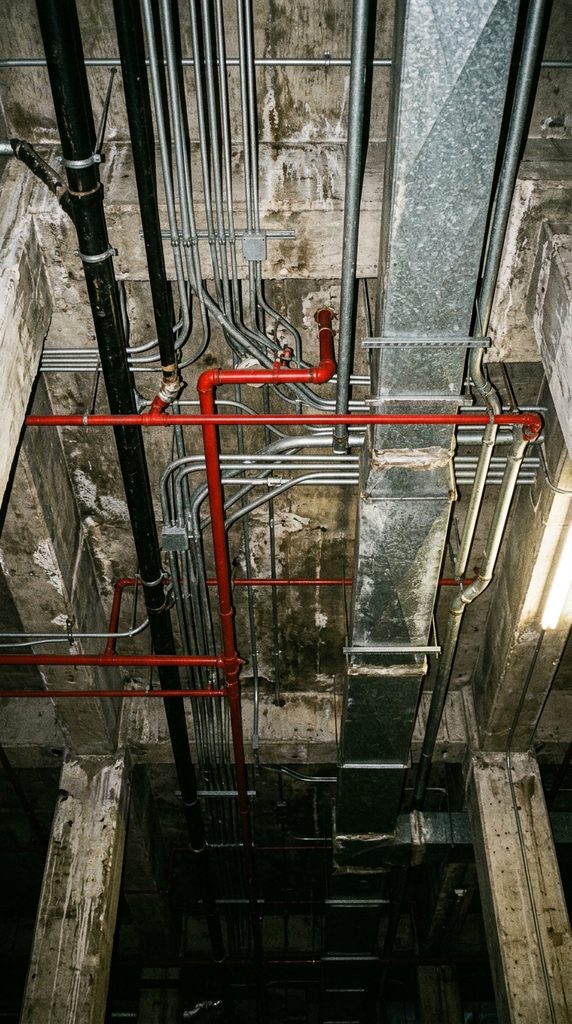
An upward-tilted architectural study focusing on the ceiling plane: a dense, chaotic network of galvanized steel conduits, thick black sewage pipes, fire-suppression risers with bright red shutoff valves, and suspended sheet-metal HVAC ducts hanging low over parking stalls.
Narrative Atmosphere
Focusing on the mechanical underbelly of the structure emphasizes its subterranean, bunker-like nature. The dense tangle of industrial infrastructure feels oppressive, like the interior ribcage of a leviathan. It strips away any illusion of modern comfort, highlighting the raw, utilitarian skeleton that traps the viewer beneath tons of reinforced earth.
Lighting and Set Dressing
- Key Lighting: Raking side-light from wall-mounted bulkheads that grazes the curved undersides of metal pipes, producing sharp specular highlights and deep shadow grooves between parallel lines.
- Details: Rust streaks bleeding down white-painted ceiling concrete, bright red fire valves with inspection tags hanging limp, and condensation glistening on cold-water supply pipes.
- Color Grade: Desaturated industrial steel, punctuated by the vivid hazard red of the fire pipes and warning labels.
Technical Camera Execution
- Focal Length: 28mm wide prime.
- Camera Height: 170 cm, tilted 45 degrees upward toward the ceiling infrastructure.
- Settings: $f/5.6$, ISO 400, 1/30s handheld with image stabilization.
- Composition: Align the linear run of major HVAC ducts diagonally across the frame to establish dynamic industrial geometry.
10. The Rooftop Deck at Blue Hour Storm Twilight
Visual Premise
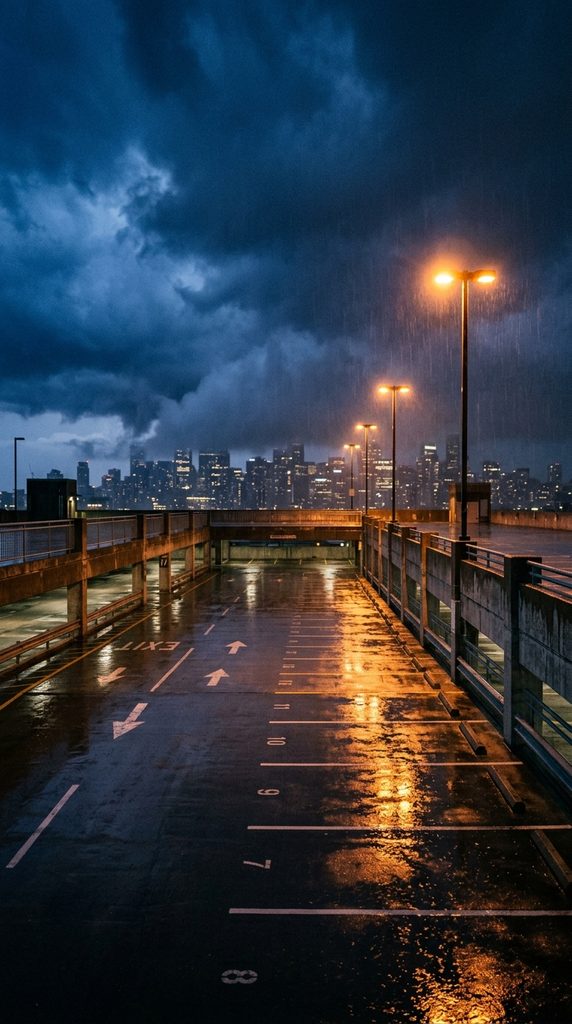
The open-air top level of a multi-story concrete parking structure. Wet, glistening deck surfaces stretch out to low perimeter parapet walls, overlooking a distant, out-of-focus city skyline veiled in heavy rain. Overhead, bruised indigo storm clouds swirl at blue hour, contrasting with the harsh orange glow of high-pressure sodium floodlights mounted on tall light poles.
Narrative Atmosphere
Transitioning to the open roof exchanges claustrophobia for agoraphobic exposure. High above the street, there is nowhere to hide from the elements or from pursuit. The juxtaposition of industrial sodium lights against an ominous storm sky evokes neo-noir climaxes—the final confrontation where escape is physically blocked by the edge of the building.
Lighting and Set Dressing
- Key Lighting: High-mounted sodium floodlights casting deep amber pools across wet asphalt, balanced against the deep indigo blue-hour skylight.
- Weather Elements: Visible rain streaks caught in the floodlight cones, puddle-rippled reflections of the surrounding skyline, and wet concrete curbs.
- Details: Puddle reflections displaying inverted city office towers and red perimeter warning lights.
Technical Camera Execution
- Focal Length: 24mm wide angle.
- Camera Height: 100 cm, capturing an equal split between the reflective wet deck and the moody storm sky.
- Settings: $f/8$, ISO 100, 2-second exposure on a locked tripod during civil twilight.
- Composition: Use the low perimeter parapet wall as a clean horizon line separating industrial concrete reflections from the brooding sky.
11. The Abandoned Narrative Relic in Stall 404
Visual Premise
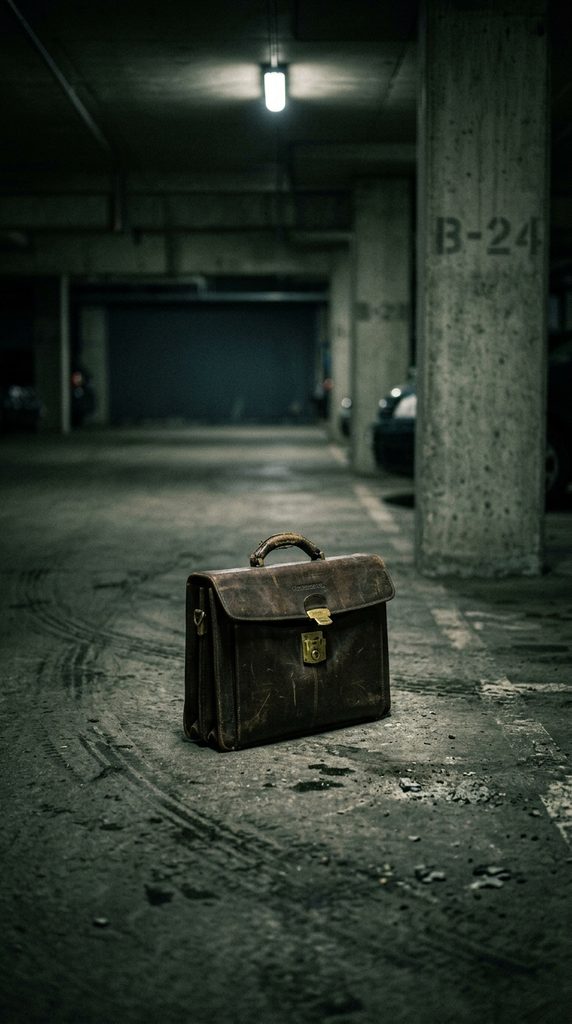
An empty, dimly lit parking stall marked with a faded, stenciled number “404.” In the center of the stall sits a single, out-of-place narrative prop: a child’s red tricycle, an abandoned leather briefcase with one latch popped open, or a single dropped high-heel shoe beside a cracked smartphone displaying an incoming call notification.
Narrative Atmosphere
In psychological thrillers, small human artifacts abandoned in vast spaces tell horrifying stories without showing violence. An everyday object left behind in an empty garage instantly implies sudden interruption, struggle, or abduction. The cavernous emptiness around the object amplifies its tragic, mysterious significance.
Lighting and Set Dressing
- Key Lighting: A single ceiling light focused directly downward onto the abandoned prop, treating it like an exhibit in a forensic crime scene.
- Shadow Perimeter: The surrounding parking bays fade into murky, deep olive-gray shadow, keeping the focus entirely on the isolated relic.
- Surface Details: Faint, scuffed shoe sole marks on the pavement, yellow stall boundary lines, and a cracked cell phone screen reflecting light.
Technical Camera Execution
- Focal Length: 50mm or 85mm prime to compress depth and isolate the subject.
- Camera Height: 40 cm (low angle, close proximity to the prop).
- Settings: $f/2$, ISO 200, 1/60s.
- Composition: Shallow depth of field; place the prop tack-sharp in the lower third, allowing the distant concrete pillars and dark empty bays to melt into soft, foreboding bokeh.
12. The Concrete Pillar Peephole Silhouette
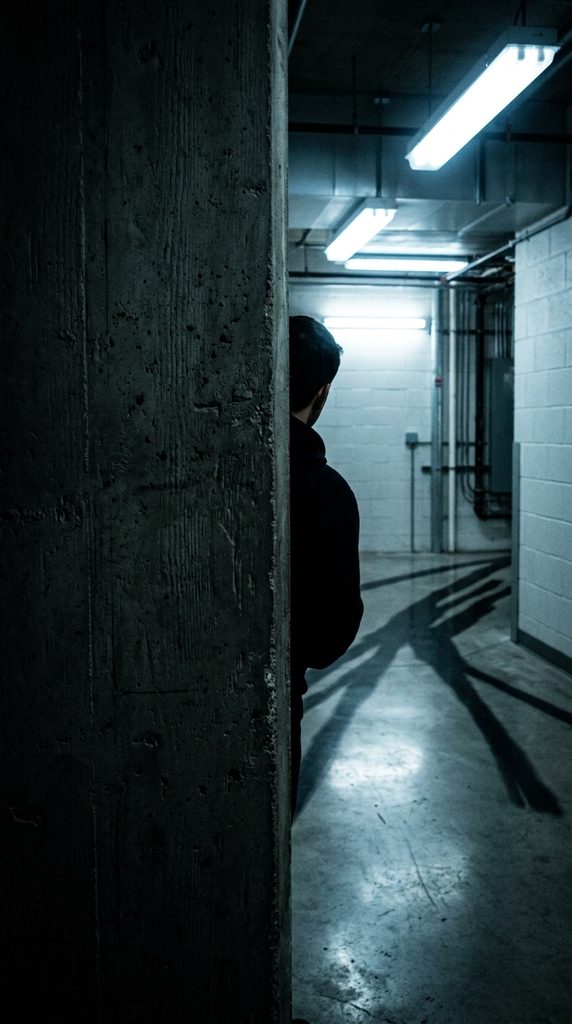
Visual Premise
A voyeuristic, over-the-shoulder frame shot from deep behind a massive octagonal concrete column. Half the frame is obstructed by the abrasive, cracked edge of the pillar in near-black silhouette, while the open half peers into a well-lit cross-aisle where distant, unexplained long shadows stretch across the floor from around a corner.
Narrative Atmosphere
This composition explicitly puts the viewer in the role of someone hiding, stalking, or evading discovery. It creates visceral, physical tension through partial occlusion—the viewer instinctively wants to look around the pillar, but the camera denies them full visual access, simulating the terrifying claustrophobia of holding one’s breath while an intruder walks past.
Lighting and Set Dressing
- Key Lighting: The illuminated cross-aisle in the background, lit by cool-white fluorescent fixtures, providing a bright backdrop against which approaching shadows can be silhouetted.
- Foreground: The near pillar is kept in near-total shadow, with just enough faint ambient bounce to reveal its rugged, chiseled concrete texture.
- Shadow Element: A long, distorted shadow of an unseen figure or vehicle front stretching diagonally into the illuminated aisle from out of frame.
Technical Camera Execution
- Focal Length: 35mm wide prime.
- Camera Height: Eye level, 160 cm, mimicking a standing person leaning against the concrete column.
- Settings: $f/4$, ISO 400, 1/40s.
- Composition: Split the frame vertically: 50% dark concrete obstruction on the left, 50% deep aisle perspective on the right.
13. The Exit Gate Arm Barrier to the Unknown
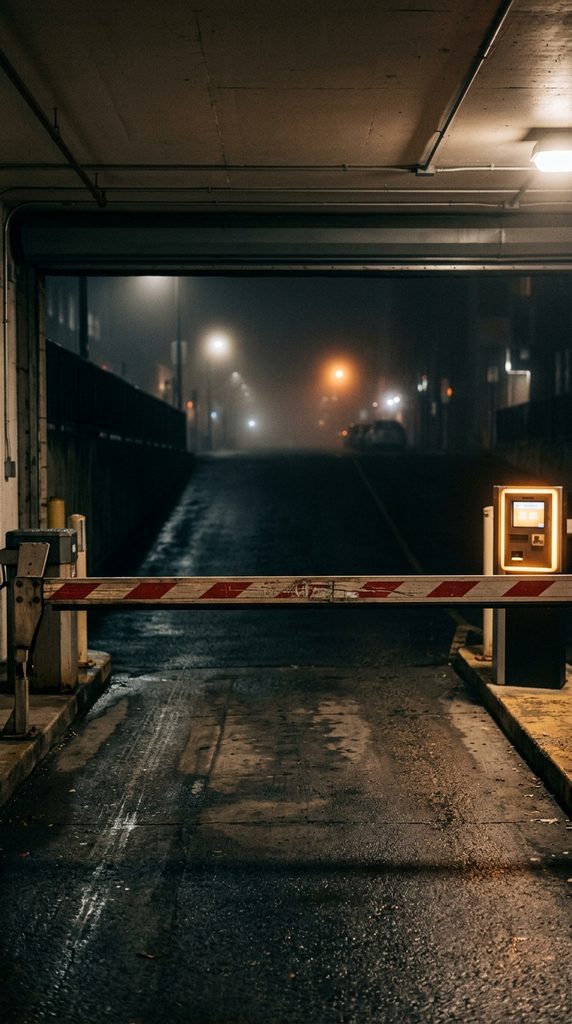
Visual Premise
The final mechanical threshold of the parking garage: an automated wooden or aluminum gate arm painted with faded red-and-white diagonal warning stripes, resting horizontally across the exit lane. The ticket dispensing machine’s LCD screen blinks an error message in bright amber, while beyond the gate, the exit tunnel opens directly into an unlit, pitch-black city street shrouded in mist.
Narrative Atmosphere
The exit gate is supposed to represent escape, freedom, and return to safety. When the barrier is closed and the street beyond is dark, it signals that escape is an illusion. The mechanical barrier becomes a physical wall, sealing the protagonist inside the concrete tomb.
Lighting and Set Dressing
- Key Lighting: The cold, harsh glare of the overhead exit canopy lights reflecting off the red-and-white reflective tape of the barrier arm, paired with the pulsing amber glow of the automated ticket kiosk screen.
- Background Contrast: The street outside the exit ramp is kept in pitch blackness, punctuated only by distant, hazy sodium-vapor streetlights through heavy fog.
- Pavement Details: Embedded inductive vehicle loop detector cuts in the asphalt, greasy yellow curb bumpers, and discarded parking validation stubs scattered on the tarmac.
Technical Camera Execution
- Focal Length: 28mm wide angle.
- Camera Height: 80 cm (waist level), directly in front of the gate arm.
- Settings: $f/5.6$, ISO 200, 1/25s.
- Composition: Use the horizontal red-and-white gate arm as a bold structural leading line cutting straight through the lower third of the frame, blocking the viewer’s forward progress visually and psychologically.
Technical Comparison: Conceptual Setups for Maximum Cinematic Tension
| Concept | Primary Focal Length | Key Lighting Temperature | Core Compositional Rule | Dominant Psychological Emotion |
| Endless Symmetrical Corridor | 24mm (Ultra-Wide) | 4500K (Sallow Cyan) | Strict Center One-Point Perspective | Inescapable Corporate Claustrophobia |
| Isolated Security Booth | 50mm (Standard) | 3200K (Amber) vs 6000K (Blue) | Rule of Thirds with Deep Negative Space | Abandonment & Lost Authority |
| Helical Spiral Ramp | 18mm (Ultra-Wide) | 2200K (Deep Amber Sconces) | Dynamic S-Curve Leading Lines | Disorientation & Downward Descent |
| Flickering Stairwell Vault | 35mm (Wide-Normal) | 5500K (Strobe-Flicker White) | Frame-within-a-Frame Door Threshold | Sudden Jolt & Anticipatory Ambush |
| Solitary Fluorescent Stall | 85mm (Telephoto) | 6500K (Sterile Daylight) | High-Contrast Center Spotlight Isolation | Extreme Exposure & Vulnerability |
| Tire-Tread Pavement Grid | 20mm (Ultra-Wide) | 4000K (Slate Gray/Cyan) | Low Hyperfocal Foreground Anchor | Ground-Level Hiding & Grounding Dread |
| Elevator Bank with Ajar Door | 35mm (Wide-Normal) | 2700K (Amber Core) / 5000K (Surface) | Balanced Linear Vertical Symmetry | Mechanical Treachery & Unknown Depths |
| Blinding Headlight Silhouette | 85mm (Telephoto) | 6000K (High-Beam Beam Flares) | Strong Backlight Lens Glare Flare | Direct Standoff & Loss of Control |
| Overhead Conduit Labyrinth | 28mm (Wide) | 3800K (Desaturated Industrial) | Dynamic Upward Diagonal Rake | Subterranean Entrapment & Weight |
| Rooftop Storm Blue Hour | 24mm (Ultra-Wide) | 2000K (Sodium) vs 8000K (Twilight) | Split-Level Deck & Brooding Skyline | Exposed Agoraphobia & Final Stand |
| Abandoned Prop in Stall 404 | 50mm / 85mm Prime | 4500K (Focused Spotlight Beam) | Shallow Depth of Field Subject Isolation | Foreboding Narrative Interruption |
| Pillar Peephole Silhouette | 35mm (Wide-Normal) | 5000K (Clean Cool Background) | Heavy Asymmetric Occlusion (50/50) | Voyeurism, Stalking & Evasion |
| Exit Gate Arm Barrier | 28mm (Wide) | 3000K (Kiosk) / 6000K (Overhead) | Horizontal Threshold Barrier Division | False Hope & Physical Blockade |
Step-by-Step Post-Processing: Crafting the Thriller Movie Grade
Capturing the raw photograph is only half the battle. Cinematic thriller stills owe their atmospheric punch to deliberate color grading and tonal calibration in post-production:
- The Black Point Calibration: Lift your absolute black point slightly using the Curves tool, but compress the shadow region directly above it. This produces dark, inky shadow density while preventing pure digital clipping, mimicking the shadow roll-off of 35mm motion picture negative stock.
- Split-Toning the Industrial Palette: Push cool teal, cyan, or murky olive-green tones into the shadows ($Hue: 175^\circ–195^\circ$, $Saturation: 12–18\%$). Balance this by keeping mid-tone concrete neutral gray and allowing warm tungsten or sodium-vapor light sources to retain a dirty amber-gold hue in the highlights.
- Fluorescent Highlight Desaturation: Industrial fluorescent bulbs often produce harsh, unnatural magenta or sickly yellow fringing when blown out. Isolate highlight luminance channels and reduce green/yellow saturation specifically in the top 10% brightness zone to keep light fixtures looking clinical and clean rather than digitally distorted.
- Local Texture and Clarity Sculpting: Use radial and linear gradient masks to brush micro-contrast (Clarity and Texture sliders) across the foreground pavement, oil stains, and concrete pillars, while gently lowering clarity on distant dark corners to draw focus toward key narrative zones.
- Authentic Film Grain Overlay: Digital noise from high ISO settings looks messy and unappealing. Instead, shoot at low native ISO on a tripod and introduce an organic, fine-to-medium 35mm film grain profile in software. A uniform layer of gentle grain ties harsh digital edges together, giving raw industrial concrete an unmistakable cinematic patina.
Executing these thirteen concepts with deliberate lighting control, patient low-angle framing, and disciplined color grading will turn any standard concrete parking structure into a masterclass in cinematic suspense.