
An entryway is the first impression of your home—and most people get it wrong. They either leave it empty and lifeless or overload it with random decor that serves no purpose. The truth is, your entryway table is not just a decorative piece; it is a functional statement zone that sets the tone for everything that follows inside your home.
In modern house design, every space has a role. The entryway is not just a passage—it is a transition point between the outside world and your personal environment. This is where guests form their first opinion, and more importantly, it is where your daily routine begins and ends. If this space is messy, poorly lit, or visually confusing, it creates a subtle sense of disorder every time you walk in. On the other hand, a well-designed entryway table creates a feeling of calm, structure, and intention.
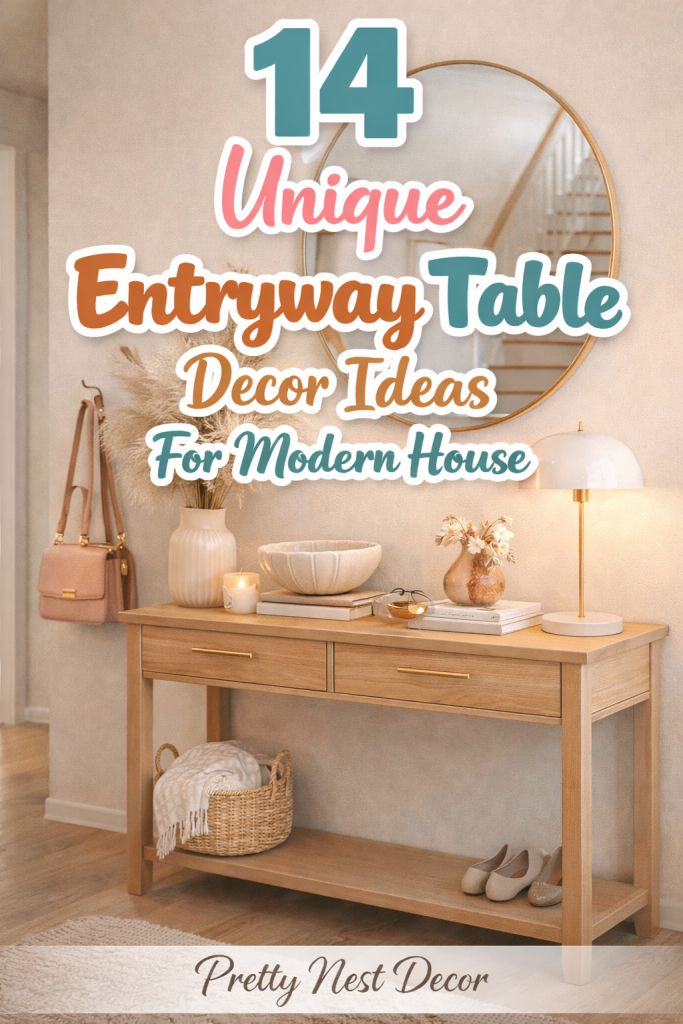
Most homeowners treat entryway decor as an afterthought. They place a table, add a random vase, maybe a mirror, and assume the job is done. That approach is shallow and ineffective. A modern entryway table should be designed like a system, not just styled for appearance. It should balance three things: functionality, visual hierarchy, and personal identity.
Functionality comes first. If your entryway table cannot support your daily habits—like dropping keys, organizing mail, or holding essential items—it will fail, no matter how beautiful it looks. This is where practical design decisions matter. Storage drawers, trays, baskets, and smart organization elements should be integrated in a way that feels natural, not forced. When your entryway supports your routine, your entire home starts feeling more controlled and organized.
The second element is visual hierarchy. Modern design is not about adding more—it is about placing the right elements in the right order. Your entryway table should have a clear focal point, whether it is a mirror, artwork, or a statement lamp. Supporting elements like vases, books, or decorative objects should enhance that focal point, not compete with it. Without hierarchy, the table looks cluttered even if it has only a few items.
Then comes identity. Your entryway should reflect your personal style, but in a controlled and intentional way. A modern home does not rely on random decorative pieces. It uses a consistent palette, clean lines, and purposeful accents. Whether your style leans toward minimal, warm modern, or luxury, your entryway table should communicate that clearly. This is where material choices—like wood, metal, glass, or stone—play a significant role.
Another critical factor is proportion. One of the most common mistakes is mismatching the size of the table with the wall or surrounding space. A table that is too small looks insignificant, while an oversized table makes the entryway feel cramped. The decor on top must also follow proportion rules. Tall items, medium elements, and smaller accents should be layered in a way that feels balanced and natural.
Lighting is often ignored in entryway design, and that is a mistake. Proper lighting transforms the entire space. A well-placed table lamp or wall sconce not only improves visibility but also adds warmth and depth. In modern interiors, lighting is not just functional—it is part of the aesthetic composition.
You also need to understand the difference between decoration and clutter. Many people think adding more items makes a space look styled, but the opposite is true. Modern design focuses on intentional minimalism. Every item on your entryway table should have a reason to be there. If it doesn’t serve a function or contribute to the visual balance, it should not be included.
If you have a small entryway, the challenge becomes even more critical. Limited space means every decision must be precise. You cannot afford bulky decor or unnecessary items. Instead, you need smart solutions like vertical styling, mirrors to create depth, and compact storage elements that maximize efficiency without sacrificing style.
For larger entryways, the risk shifts from lack of space to lack of structure. A big area can feel empty and disconnected if not styled properly. In this case, layering becomes important—combining lighting, decor, and functional elements to create a cohesive and inviting setup.
Ultimately, a modern entryway table is about control. It controls clutter, defines your style, and sets the emotional tone of your home. It is the first thing you interact with when you enter and the last thing you see when you leave. If this space is designed with intention, it quietly improves your daily experience without you even noticing.
In the following ideas, you will explore 14 unique entryway table decor ideas for a modern house, each designed with real functionality, smart styling techniques, and practical implementation. These are not random decoration tips—they are structured approaches that help you create an entryway that actually works, looks refined, and reflects a modern lifestyle.
Idea 1: Statement Mirror + Minimal Table Styling (Clean Focal Point System)
What it is
This setup is built around one principle: clarity over clutter. Instead of filling your entryway table with multiple decorative items, you create a strong focal point using a large mirror and support it with minimal, intentional decor.
The mirror does most of the visual work. It reflects light, expands space, and gives the illusion of depth—especially important if you have a small or narrow entryway. The table becomes a base, not the main attraction. This is how modern interiors achieve that “effortless” look.
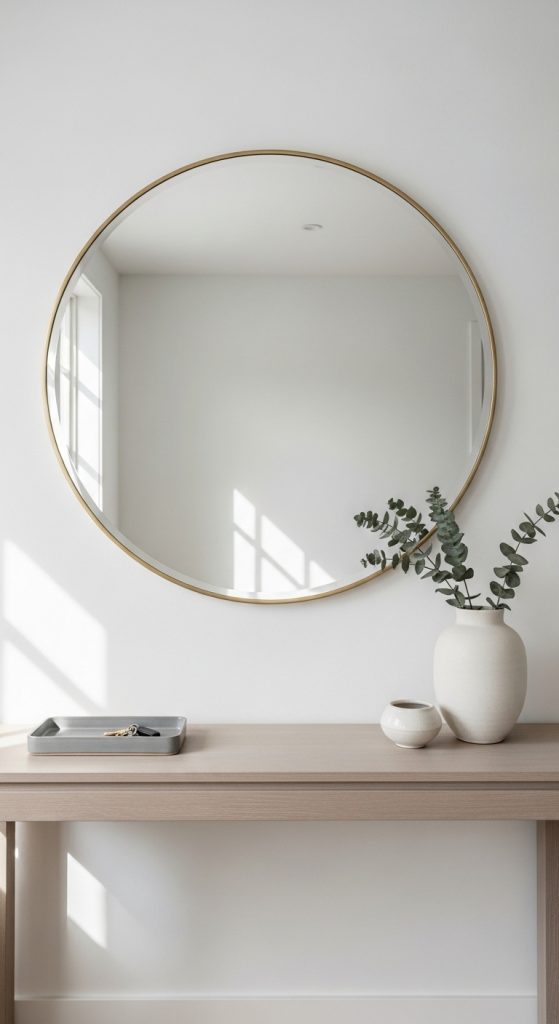
How to implement it (step-by-step)
- Choose a large mirror (round or rectangular) proportional to your wall
- Center the mirror above the entryway table
- Keep the table decor limited to 3–5 items max:
- a small tray (for keys and essentials)
- one vase (fresh or dried stems)
- a stack of 2–3 books for layering
- Use symmetry or near-symmetry for balance
- Keep color palette neutral (white, beige, black, wood tones)
Optional upgrade:
- Add a slim table lamp on one side for warmth
Best for
- Small entryways
- Minimalist modern homes
- Apartments with limited light
- People who prefer clean, uncluttered spaces
Pro tip
If you have a small room, a mirror is not decor—it is a space amplifier. Go bigger than you think.
Mistake to avoid
Do not add too many small objects. That instantly breaks the clean modern look.
Idea 2: Layered Lighting + Decor Composition (Depth Creation Design)
What it is
This idea focuses on creating visual depth using layered elements, especially lighting. Instead of relying on overhead lighting, you use table lamps and decor layering to create a warm, inviting entry experience.
Modern design is not flat—it uses layers to guide the eye and create dimension.
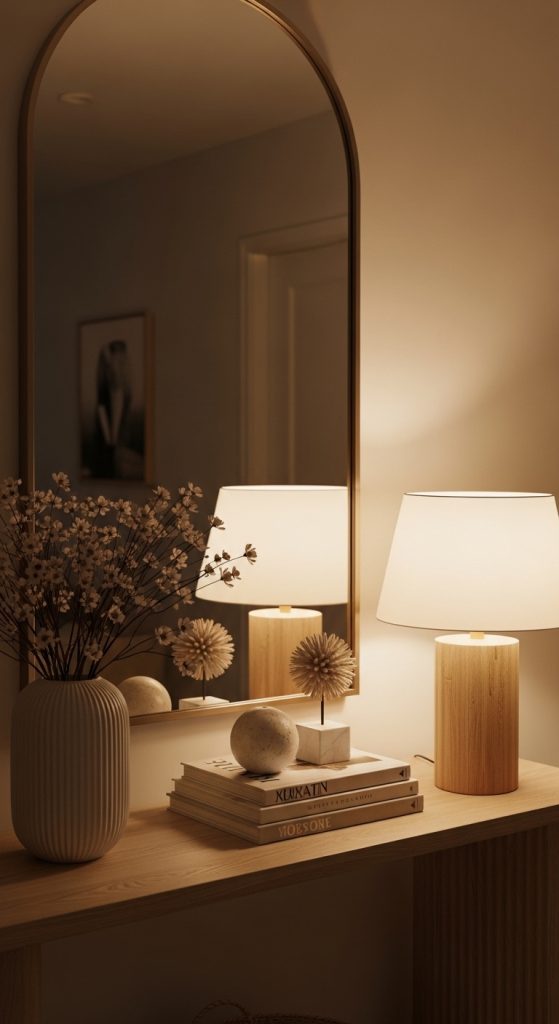
How to implement it
- Place a table lamp on one side of the entryway table
- Add a medium-height object on the opposite side (vase or sculpture)
- Use a mirror or artwork as the background layer
- Include a tray or small bowl for functional items
- Keep height variation:
- tall (lamp or mirror)
- medium (vase or decor)
- low (tray or books)
Optional upgrade:
- Use warm light bulbs (soft yellow tone) for cozy atmosphere
Best for
- Medium to large entryways
- Homes lacking natural light
- Cozy modern interiors
- Evening-focused ambiance lovers
Pro tip
Lighting changes perception more than decor. One good lamp can elevate the entire setup.
Mistake to avoid
Do not use harsh white lighting—it kills the warmth of the entry space.
Idea 3: Functional Tray Organization System (Clutter Control Design)
What it is
This idea prioritizes daily usability without sacrificing style. The tray becomes the control center for everyday items like keys, wallets, sunglasses, and small essentials.
Instead of scattering items across the table, everything is contained within a defined area.

How to implement it
- Place a medium-sized tray at center or side of table
- Use it to organize:
- keys
- small accessories
- Add one decorative element inside tray (small candle or plant)
- Keep rest of table minimal
- Choose tray material that matches your style:
- wood (warm modern)
- marble (luxury)
- metal (industrial modern)
Optional upgrade:
- Use divided tray for better organization
Best for
- Busy households
- People who lose items easily
- Small entry tables
- Functional design lovers
Pro tip
A tray is not decoration—it is a boundary system. It controls clutter visually and physically.
Mistake to avoid
Do not overload the tray. If it becomes messy, the whole table looks messy.
Idea 4: Artwork + Sculptural Decor Styling (Modern Personality Expression)
What it is
This design turns your entryway table into a personal expression zone using bold artwork and sculptural decor pieces. Instead of traditional styling, this approach focuses on individuality and artistic presence.
It makes your entryway feel curated, not generic.
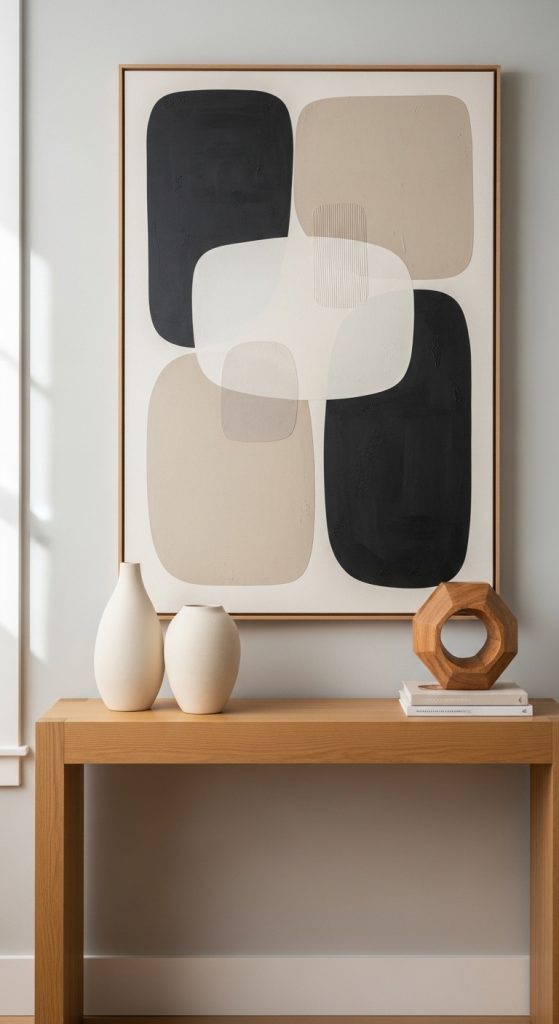
How to implement it
- Choose one large artwork or framed print
- Lean it against the wall or mount it above table
- Add 1–2 sculptural objects (ceramic, metal, abstract forms)
- Keep rest of table simple
- Use contrast:
- light wall + dark decor
- dark wall + light decor
Optional upgrade:
- Add spotlight or accent light to highlight artwork
Best for
- Modern and contemporary homes
- Creative personalities
- Large entryway spaces
- Statement design lovers
Pro tip
One bold piece is stronger than five average ones. Choose impact over quantity.
Mistake to avoid
Do not mix too many styles. Keep a consistent artistic direction.
Idea 5: Natural Elements + Organic Styling (Warm Modern Design)
What it is
This idea focuses on bringing natural textures and organic elements into your entryway. It creates a calm, welcoming environment that feels grounded and balanced.
Modern homes often feel cold—this design fixes that by adding warmth through nature-inspired decor.

How to implement it
- Use wooden entryway table or add wood accents
- Add greenery:
- fresh plants
- dried pampas grass
- Include stone or ceramic decor pieces
- Keep colors earthy:
- beige
- olive green
- warm brown
- Use woven baskets or trays
Optional upgrade:
- Add natural fiber rug below table
Best for
- Warm modern interiors
- Nature-inspired homes
- Cozy minimalist spaces
- Relaxation-focused environments
Pro tip
Mix textures, not colors. Texture creates depth without visual chaos.
Mistake to avoid
Do not use fake-looking plants—they ruin the natural aesthetic instantly.
Idea 6: Symmetrical Styling Layout (Balanced Formal Design)
What it is
This design uses perfect symmetry to create a clean, structured, and elegant entryway. Everything is balanced on both sides, giving a sense of order and control.
It is ideal for people who prefer neat, organized environments.
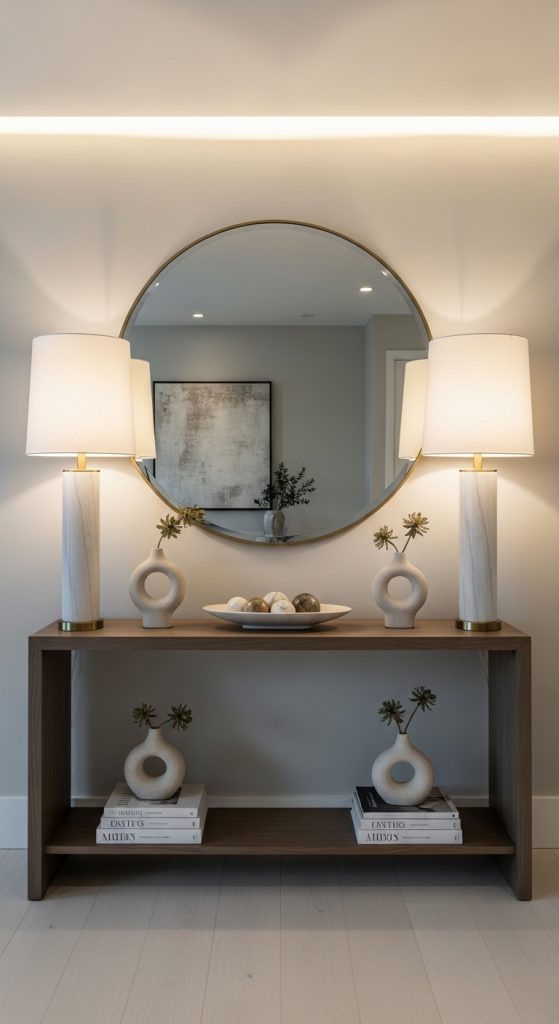
How to implement it
- Place mirror or artwork at center
- Add identical lamps or decor items on both sides
- Keep equal spacing between elements
- Use matching colors and materials
- Align everything precisely
Optional upgrade:
- Add matching baskets or stools underneath table
Best for
- Formal modern homes
- Large entryways
- Structured design lovers
- Clean aesthetic spaces
Pro tip
Symmetry creates instant visual calm. It is the fastest way to make a space look “put together.”
Mistake to avoid
Do not break symmetry with random items—it ruins the entire concept.
Idea 7: Mixed Height Layering Technique (Dynamic Visual Composition)
What it is
This design focuses on creating movement and interest through height variation. Instead of placing everything at the same level, you layer objects in different heights to guide the eye.
This makes even simple decor look intentional and styled.
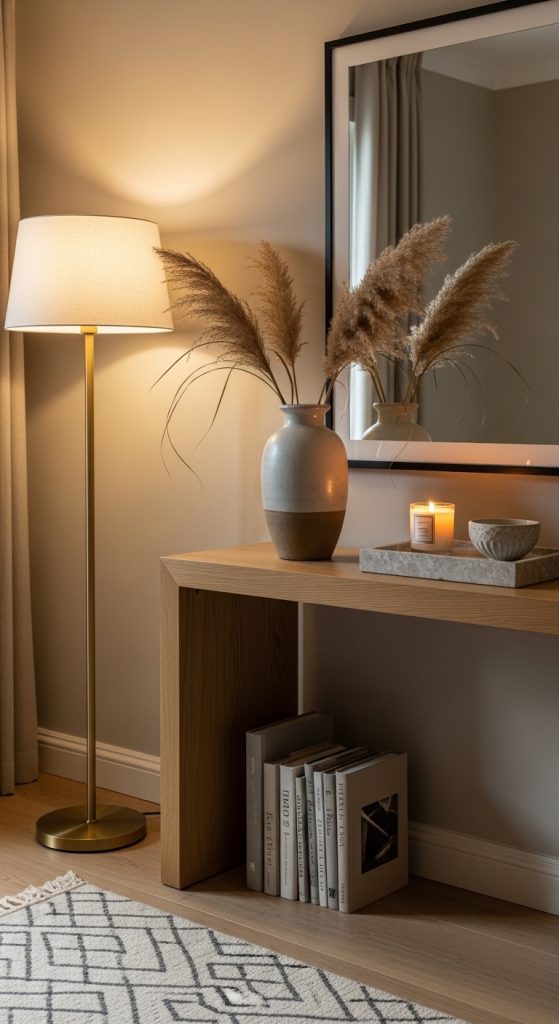
How to implement it
- Choose 3 height levels:
- tall (lamp, branches, mirror)
- medium (vase, sculpture)
- low (books, tray)
- Arrange items in a triangular composition
- Keep spacing natural, not rigid
- Use odd-number grouping (3 or 5 items)
- Maintain color consistency
Optional upgrade:
- Add vertical wall paneling or art to enhance height effect
Best for
- Medium entryways
- Style-focused homeowners
- Modern layered interiors
- Pinterest-inspired setups
Pro tip
Your eye should move smoothly from tall → medium → low. If it feels jumpy, the composition is wrong.
Mistake to avoid
Do not place all items in a straight line—it kills depth and makes the table look flat.
Idea 8: Console Table + Under-Storage Styling (Hidden Function Design)
What it is
This design focuses on maximizing both the top surface and the space underneath the entryway table. Most people completely waste the lower section, but in modern homes, every inch matters—especially in entry areas where clutter builds quickly.
The goal is to keep the top visually clean while using the bottom for hidden or semi-hidden storage. This creates a balance between aesthetics and real-life functionality.
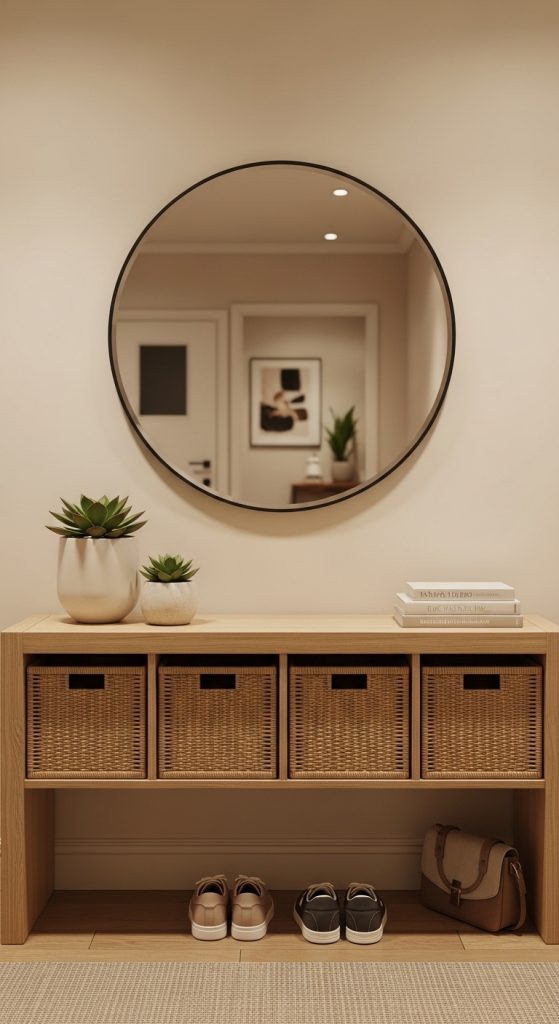
How to implement it
- Choose a console table with open space underneath
- Add baskets, bins, or storage boxes below:
- shoes
- bags
- seasonal items
- Keep top styling minimal:
- mirror or artwork
- small tray
- one decorative piece
- Use matching baskets for a clean look
- Align everything neatly to avoid visual clutter
Optional upgrade:
- Add labeled storage bins for organized system
Best for
- Small entryways
- Families with daily clutter
- Functional modern homes
- Storage-focused setups
Pro tip
Hide the mess below, keep the top clean. This is how modern homes look organized even when life is busy.
Mistake to avoid
Do not mix random baskets or colors—it ruins the clean visual structure.
Idea 9: Minimal Black & White Contrast Styling (Bold Modern Statement)
What it is
This design uses a high-contrast color scheme to create a bold, modern entryway. Instead of multiple colors, it relies on black, white, and subtle neutrals to achieve a strong visual impact.
It is simple, but very powerful when done correctly.
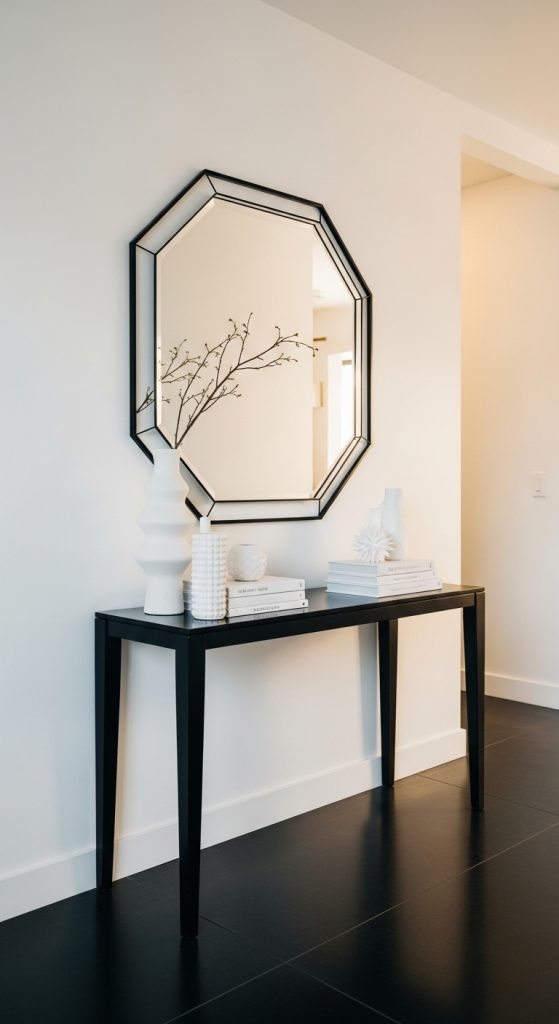
How to implement it
- Choose a black or white console table
- Use contrasting decor:
- white vase on black table
- black frame on white wall
- Add geometric or abstract artwork
- Keep decor limited and sharp in form
- Use matte finishes for modern feel
Optional upgrade:
- Add metallic accent (gold or chrome) for depth
Best for
- Ultra-modern interiors
- Minimalist design lovers
- Small spaces needing strong identity
- High-contrast aesthetic homes
Pro tip
Contrast works best when it is controlled. Stick to 2–3 tones only.
Mistake to avoid
Do not add random colors—it weakens the bold modern effect instantly.
Idea 10: Entryway Table + Statement Lighting Focus (Mood-Centered Design)
What it is
This idea makes lighting the hero of the entryway, with decor playing a supporting role. Instead of focusing only on objects, the entire setup revolves around how light shapes the mood of the space.
Lighting becomes both functional and decorative.
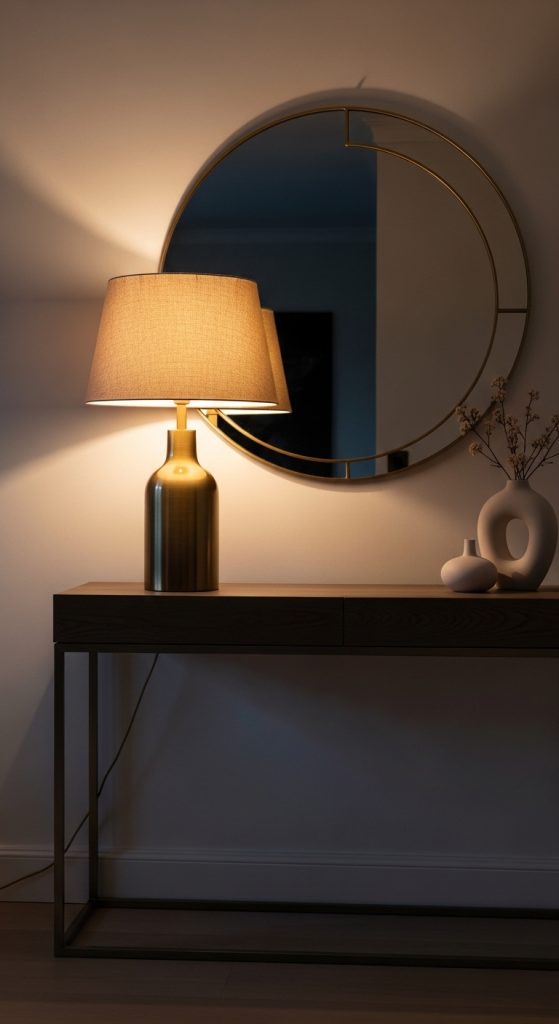
How to implement it
- Place a large table lamp or pair of lamps on the console
- Use warm light bulbs for soft glow
- Add mirror or reflective surface behind to amplify light
- Keep decor minimal so lighting stands out
- Position table near wall outlet for clean setup
Optional upgrade:
- Add wall sconces for layered lighting effect
Best for
- Dark entryways
- Evening-focused homes
- Cozy modern interiors
- Mood-driven design lovers
Pro tip
Lighting should create a soft glow, not harsh brightness. Think atmosphere, not spotlight.
Mistake to avoid
Do not use cold white bulbs—they make the space feel sterile.
Idea 11: Floating Console + Minimal Decor (Airy Space Design)
What it is
This design removes visual heaviness by using a floating console table mounted on the wall, creating an open, airy feel. It is perfect for small spaces where floor clutter makes the area feel tight.
The space feels lighter, cleaner, and more modern.
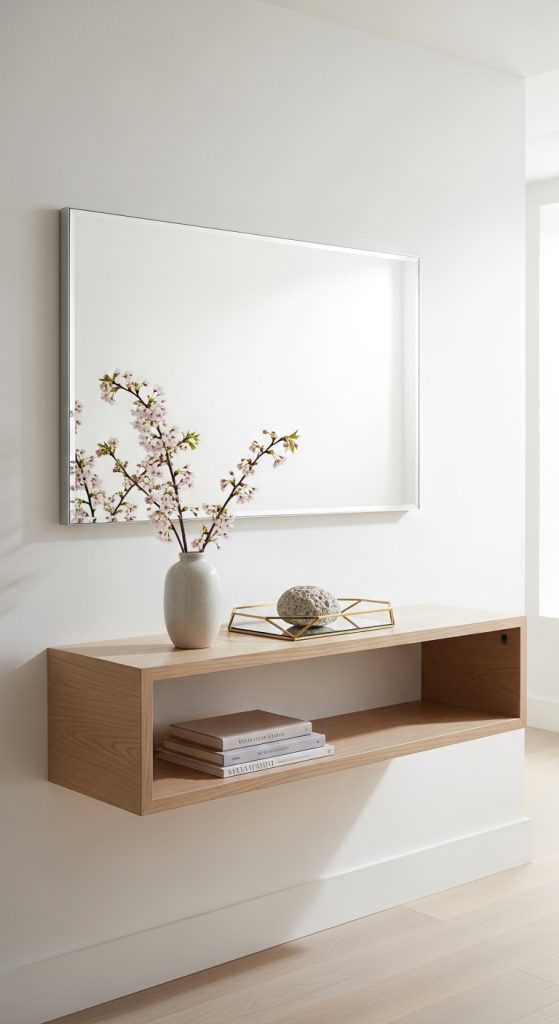
How to implement it
- Install wall-mounted floating console
- Keep space underneath empty for openness
- Add minimal decor:
- small vase
- compact tray
- Use mirror above to enhance depth
- Keep color palette light and neutral
Optional upgrade:
- Add hidden drawer in floating unit
Best for
- Small entryways
- Narrow hallways
- Minimalist interiors
- Modern apartments
Pro tip
Empty space is part of design. Do not try to “fill” everything.
Mistake to avoid
Do not overload a floating console—it defeats the purpose of lightness.
Idea 12: Seasonal Styling Entryway Table (Rotating Decor Concept)
What it is
This idea keeps your entryway fresh by rotating decor based on seasons or occasions. Instead of a static setup, the table evolves throughout the year.
This adds life and variation without changing furniture.
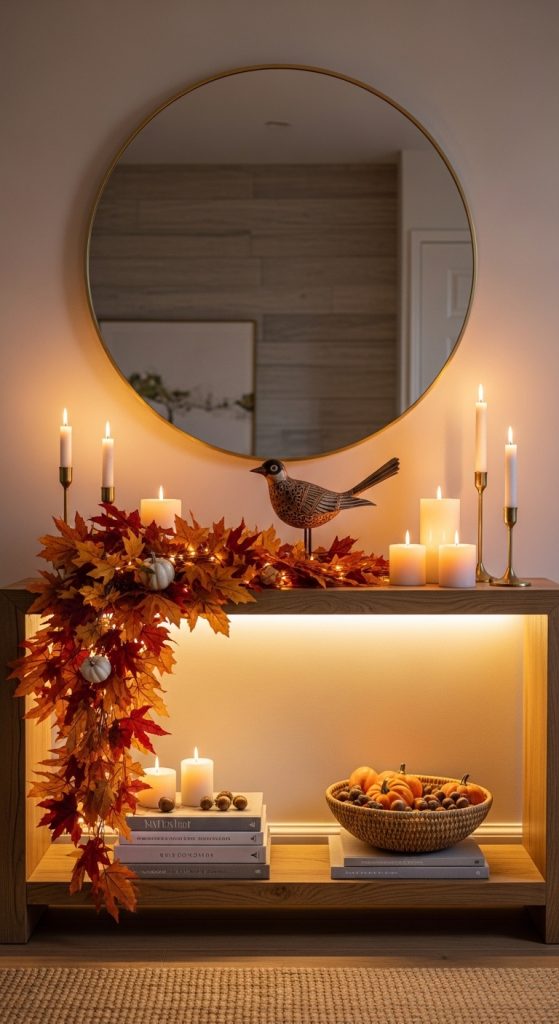
How to implement it
- Keep base setup consistent:
- mirror
- tray
- lamp
- Change accent decor seasonally:
- spring: flowers, light colors
- autumn: warm tones, dried leaves
- winter: candles, soft textures
- Store extra decor in labeled boxes
- Rotate small items, not entire setup
Optional upgrade:
- Add subtle scent elements (candles or diffusers)
Best for
- Creative homeowners
- Pinterest-inspired interiors
- Families who enjoy seasonal decor
- Dynamic home styling
Pro tip
Keep changes subtle. Over-decorating for seasons looks forced.
Mistake to avoid
Do not clutter the table with too many seasonal items.
Idea 13: Industrial Modern Entryway Styling (Raw Material Design)
What it is
This design uses raw materials like metal, wood, and concrete to create a strong industrial-modern look. It feels bold, slightly rugged, but still controlled and stylish.
Perfect for modern homes with character.
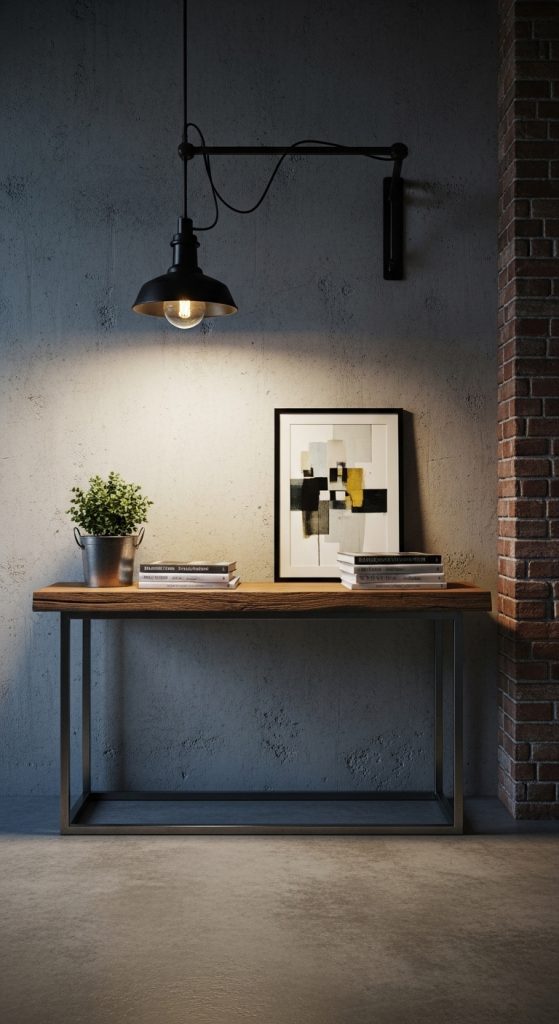
How to implement it
- Choose metal-frame console table
- Use wood or concrete surface
- Add industrial-style decor:
- metal lamp
- wire baskets
- raw wood elements
- Keep color palette dark and neutral
- Add minimal greenery for contrast
Optional upgrade:
- Exposed bulb lighting fixture
Best for
- Loft-style homes
- Industrial interiors
- Masculine design preferences
- Urban modern spaces
Pro tip
Balance raw materials with one soft element (plant or fabric) to avoid harshness.
Mistake to avoid
Do not overdo industrial elements—it can feel cold and uninviting.
Idea 14: Luxury Marble + Gold Accent Styling (High-End Entry Design)
What it is
This design creates a luxury entryway experience using premium materials and refined styling. It focuses on elegance, simplicity, and high-quality finishes.
Everything feels polished and intentional.
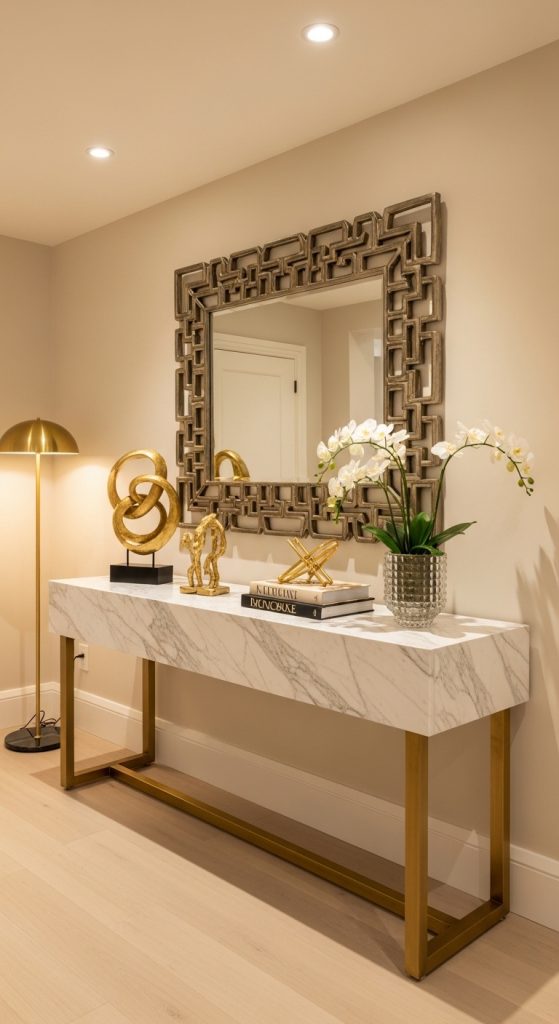
How to implement it
- Choose marble-top console table
- Add gold or brass accents:
- lamp
- tray
- mirror frame
- Keep decor minimal but premium:
- crystal vase
- sculptural decor
- Use soft neutral tones (white, cream, beige)
- Add ambient lighting for glow
Optional upgrade:
- Add upholstered bench or ottoman nearby
Best for
- Luxury homes
- Elegant interiors
- High-end modern design
- Statement entryways
Pro tip
Luxury comes from material quality, not quantity. Use fewer but better pieces.
Mistake to avoid
Do not mix cheap decor with luxury materials—it breaks the entire aesthetic.
Final Insight (What Actually Works)
Most entryway setups fail because they focus only on decoration, not function. The best designs above follow one rule:
👉 Control clutter → define a focal point → maintain balance
If your entryway does these three things, it will always look modern and intentional—no matter your style.