
Most Minecraft players mess up jungle builds before they even start. They either overbuild with too much wood and clutter, or they try to force modern structures into a biome that is already naturally chaotic. The result usually looks out of place—like a clean house dropped into a wild, dense forest that doesn’t belong. If you’re searching for “Easy Minecraft Jungle House Ideas,” the real goal isn’t just to build a house. It’s to build something that blends into the jungle instead of fighting it.
The jungle biome in Minecraft is one of the most visually rich environments in the game. It has dense trees, vines, uneven terrain, and constant natural detail everywhere you look. That’s exactly what makes it both exciting and difficult to build in. Many players underestimate how important integration is. A jungle house is not just a structure—it’s part of an ecosystem. If your build ignores the environment, it will look artificial no matter how detailed it is.
In 2026 Minecraft building trends, jungle builds are shifting toward “adaptive design.” That means players are no longer flattening terrain or clearing everything out. Instead, they are building around the jungle—using trees as support, vines as decoration, and elevation as structure. This approach creates more immersive worlds and feels closer to survival reality, where you don’t control nature—you adapt to it.
Another common mistake is choosing the wrong materials. Players often default to stone bricks, quartz, or modern blocks that clash with the jungle theme. But jungle builds work best when they stay within natural palettes: jungle wood, stripped logs, leaves, bamboo, mud, and stone. These materials don’t just match visually—they feel like they belong. When you stick to biome-appropriate blocks, even a simple house can look professional.
If you have a small space in the jungle, simplicity becomes even more important. Overbuilding will make your structure feel cramped and hidden in a bad way. But if you have a large jungle area, the challenge is different—you need enough structure and variation so your build doesn’t disappear into the environment. Balance is the key in both cases. A good jungle house should stand out just enough to be noticeable, but not so much that it breaks immersion.
Vertical building is another major factor. Jungle terrain is uneven by nature, so flat foundations often feel unnatural. Smart builders use treehouses, elevated platforms, rope bridges, and layered structures that follow the height of the forest canopy. This creates movement and depth instead of flat, lifeless ground builds. It also makes exploration inside your build feel more dynamic.
You also need to think about connectivity. A jungle house shouldn’t feel isolated. Paths made of wood slabs, hanging bridges, or natural clearings help connect different parts of your build. Without this, even a well-designed house feels disconnected from its surroundings.
Lighting is another overlooked detail. Jungle biomes are naturally dark because of dense tree cover. If you don’t plan lighting properly, your build can look gloomy or unsafe. But over-lighting it with torches everywhere ruins the natural atmosphere. The goal is controlled lighting—hidden lanterns, glow accents, or subtle light sources that don’t break immersion.
This guide is designed to fix all of those problems. Instead of random ideas, you’ll get structured, easy Minecraft jungle house concepts that actually work inside the biome. Each idea will focus on blending, material choice, terrain adaptation, and practical building logic so your house doesn’t just exist in the jungle—it belongs there.
Because in a biome like this, the difference between a good build and a great one is simple: one ignores the jungle, the other becomes part of it.
Idea 1: Treehouse Platform Base (Starter Jungle Survival Home)
What it is
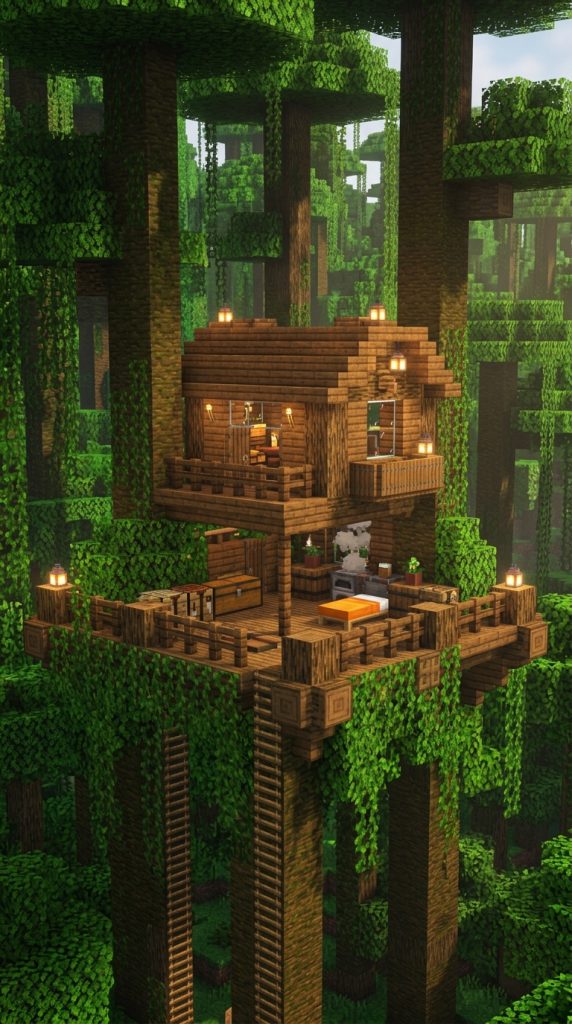
The treehouse platform base is the most reliable and beginner-friendly jungle house idea. Instead of fighting the terrain, you use it—building directly between or on top of large jungle trees. The structure is usually a flat wooden platform supported by logs, connected across branches, forming a small elevated home above ground level.
In 2026 jungle builds, this style remains dominant because it solves three major problems at once: hostile mobs on the ground, uneven terrain, and lack of visibility. By moving your base upward, you instantly gain safety and a strong survival advantage without needing complex defenses.
It’s not just a house—it becomes your first “safe zone” inside the jungle ecosystem.
How to implement it (practical steps)
Start by finding two or more tall jungle trees close to each other. The denser the canopy, the better the natural integration.
Build support pillars using jungle logs from trunk to trunk. These act as the foundation for your platform.
Create a flat floor using planks, but avoid making it a perfect square. Slight irregular shapes blend better with natural trees.
Add basic essentials first: crafting table, bed, storage, and furnace. Keep it functional before decorative.
Connect nearby trees using small bridges or walkways so the base feels like a connected system instead of a single platform.
Use leaves and vines around edges to soften the structure and make it feel grown into the jungle.
Best for
- Early survival players
- Small to medium jungle biomes
- Players who want safety first
- Minimal-resource builds
Pro tip
Do not flatten the trees around your base. Let the jungle stay dense—your house should sit inside it, not replace it.
Mistake to avoid
Avoid building too low. If your platform is near ground level, you lose the main advantage of jungle treehouses: safety and visibility.
Idea 2: Vine-Covered Jungle Cabin (Blended Ground House)
What it is
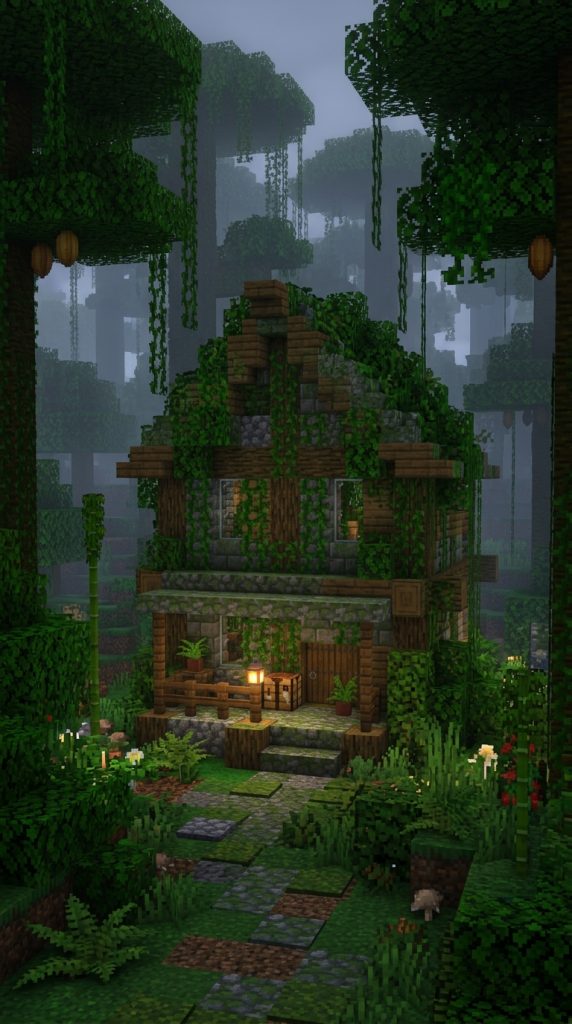
The vine-covered jungle cabin is a ground-level house designed to look like it naturally grew inside the jungle over time. Instead of a clean, modern build, this house uses mossy textures, jungle wood, leaves, and vines to create a “forgotten explorer cabin” feel.
In 2026 design trends, this type of build is popular because it focuses on storytelling. It doesn’t just look like a house—it feels like something that has existed in the jungle for years.
This is ideal for players who want immersion over perfection.
How to implement it (practical steps)
Choose a slightly open patch in the jungle, preferably near trees and uneven terrain.
Build a small rectangular or L-shaped cabin using jungle logs and planks. Keep it compact—jungle builds should never be oversized.
Replace some normal blocks with mossy cobblestone or stone to create an aged effect.
Add vines growing over walls, roof edges, and corners. Let them spread naturally instead of placing them symmetrically.
Build a small porch or entrance area with a slightly raised wooden step.
Scatter leaves around the base and integrate nearby plants so the structure blends into the environment.
Best for
- Roleplay or survival storytelling worlds
- Medium jungle biomes
- Players who like grounded builds
- Immersion-focused builders
Pro tip
Let parts of the house look “unfinished” or naturally overgrown. Perfect builds look artificial in jungles.
Mistake to avoid
Do not overuse bright or modern blocks. Quartz, concrete, or glass-heavy designs break immersion completely in jungle environments.
Idea 3: Jungle Cliffside Hanging House (Vertical Adventure Build)
What it is
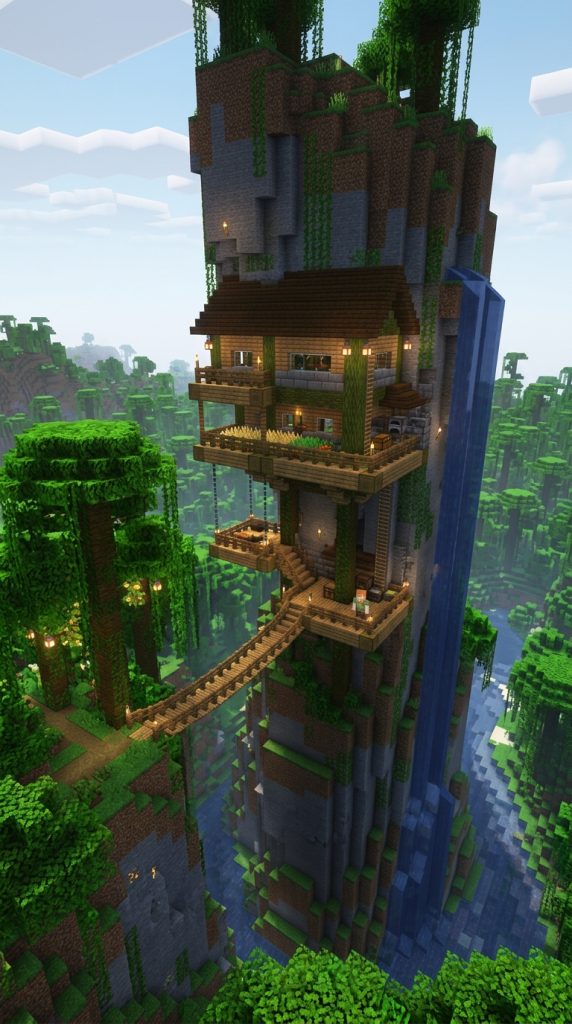
The jungle cliffside hanging house is a vertical build attached to cliffs, steep jungle hills, or ravine edges. Instead of sitting on flat land, the house is partially suspended or anchored into the side of a mountain, creating a dramatic and adventurous structure.
This idea works extremely well in jungle biomes because many seeds naturally generate uneven terrain. Instead of flattening it, you turn it into a feature.
In modern Minecraft building trends, vertical integration is considered advanced design thinking—even in simple builds.
How to implement it (practical steps)
Find a cliff, ravine wall, or steep jungle slope with strong elevation changes.
Build a main support frame using jungle logs anchored into the cliffside.
Create a small house structure that extends outward from the rock, partially hanging over open space.
Use slabs and stairs to shape the floor so it follows the natural slope instead of forcing flat geometry.
Add rope-like details using fences or chains to simulate suspension support.
Connect the house to nearby trees or ground paths using wooden bridges or vine ladders.
Best for
- Advanced survival players
- Large jungle or mountainous biomes
- Players who want dramatic builds
- Exploration-focused worlds
Pro tip
Use uneven extensions—let parts of the house stick out at different depths. This creates a realistic “built over time” effect.
Mistake to avoid
Do not over-flatten the cliff just to make building easier. The entire point of this idea is to use the natural height differences, not erase them.
Idea 4: Bamboo Jungle Hut Village Cluster (Compact Survival Base)
What it is
The bamboo jungle hut village cluster is a grouped set of small huts built using bamboo, jungle wood, and simple natural materials. Instead of one large house, you create multiple tiny functional huts—sleeping hut, storage hut, crafting hut—arranged closely like a mini survival village inside the jungle.
In 2026 Minecraft building style, modular survival bases are becoming more popular because they are easier to expand, easier to defend, and feel more realistic than one oversized structure. This design fits perfectly in dense jungle biomes where space is irregular and visibility is limited.
It feels less like a house and more like a living settlement.
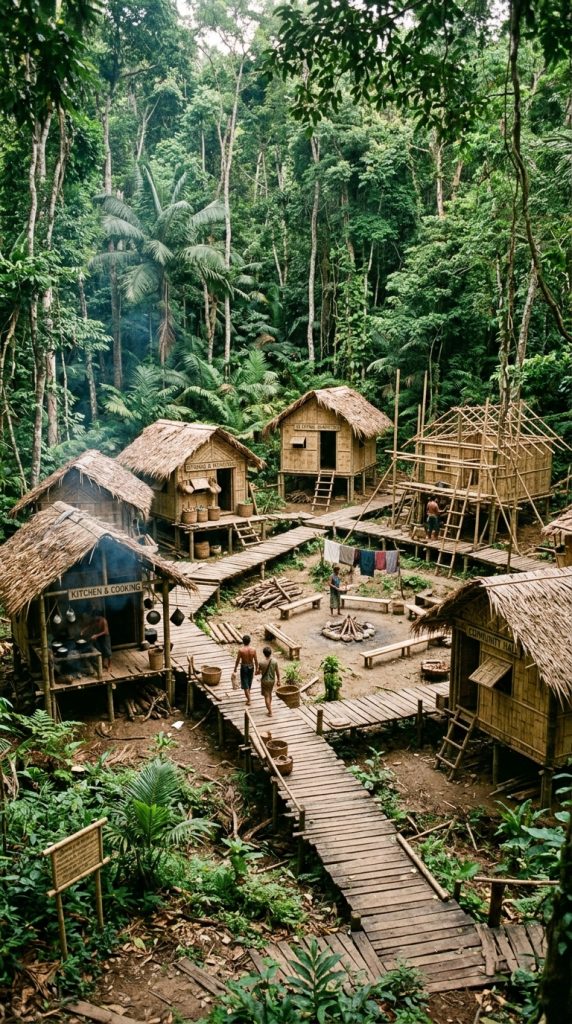
How to implement it (practical steps)
Start by clearing only small patches of jungle—do not flatten large areas. Keep natural trees and vines intact.
Build 3–5 small huts instead of one large house. Each hut should have a single purpose (bed, storage, crafting, smelting, farming support).
Use bamboo as scaffolding, support poles, or decorative framing. Jungle wood should be your main structure material.
Connect huts using narrow wooden paths or stepping stones instead of wide roads. This keeps the jungle feel intact.
Add leaf roofs, vines, and hanging lanterns to blend structures into the environment.
Best for
- Survival mode players
- Medium jungle biomes
- Players who like organized systems
- Easy expansion builds
Pro tip
Keep each hut slightly different in shape and height. Uniform huts make the build feel artificial.
Mistake to avoid
Do not merge all functions into one hut. That defeats the purpose of a “village cluster” and reduces efficiency and immersion.
Idea 5: Jungle Canopy Bridge House (Elevated Network Build)
What it is
The jungle canopy bridge house is a connected system of elevated platforms and bridges built across treetops. Instead of a single base, your entire living space is spread across multiple trees, forming a network of walkways, small rooms, and lookout points high above the jungle floor.
This design is heavily influenced by survival strategy builds in modern Minecraft. Staying above ground reduces mob threats and gives full visibility of the surrounding jungle.
It also creates one of the most cinematic jungle experiences you can build.
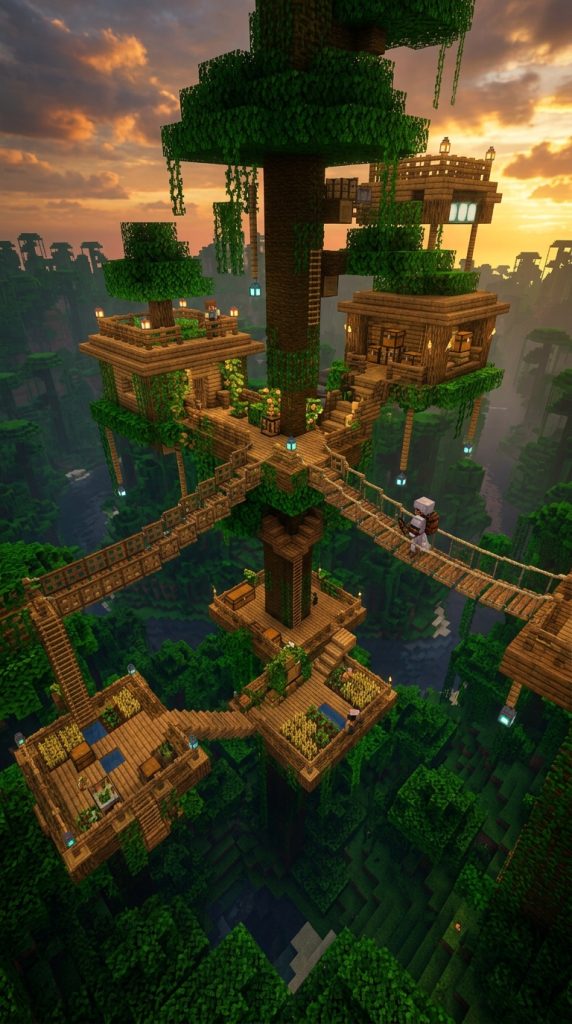
How to implement it (practical steps)
Find a dense area of tall jungle trees with close spacing.
Start by building one main platform as your “core hub” for storage and bed setup.
Extend wooden bridges from this hub to nearby trees using slabs, fences, or full planks.
Create small platforms at each connection point—each can serve a different function (farm, lookout, enchantment, etc.).
Use vines and leaves along bridge edges to make transitions feel natural instead of artificial.
Add lanterns at intervals to prevent mobs from spawning and to guide movement at night.
Best for
- Advanced survival players
- Large jungle biomes
- Exploration-style gameplay
- Players who enjoy vertical navigation
Pro tip
Do not make all bridges straight. Slight height changes and curves make the canopy feel more realistic and immersive.
Mistake to avoid
Avoid overconnecting everything. Too many bridges make the layout confusing and reduce the feeling of separate “tree zones.”
Idea 6: Hidden Jungle Waterfall Base (Secret Survival Hideout)
What it is
The hidden jungle waterfall base is a concealed house built behind or inside a waterfall, often integrated into a cliff or mountain wall. From the outside, it looks like natural terrain, but behind the water is a fully functional hidden base.
In 2026 Minecraft builds, secret bases are trending again because players value immersion and discovery. This idea combines survival practicality with aesthetic secrecy.
It is especially powerful in jungle biomes where waterfalls naturally occur due to uneven terrain.
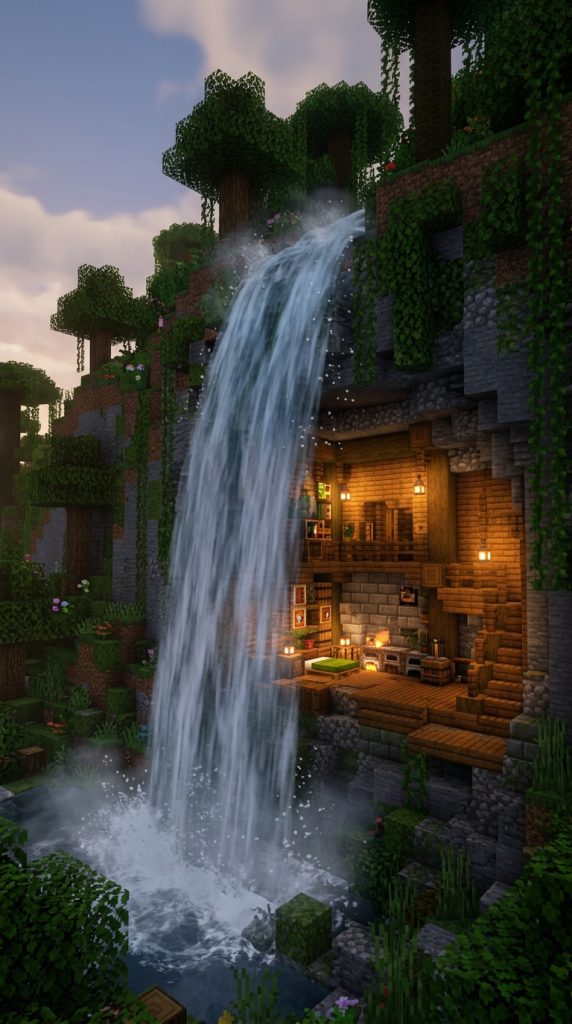
How to implement it (practical steps)
Find a jungle waterfall flowing down a cliff or steep hill.
Dig or carve a small space behind the waterfall without destroying the natural water flow.
Seal the entrance so it is only accessible by walking through or behind the water curtain.
Build a compact base inside with essential survival stations: bed, storage, crafting, and furnace setup.
Use stone, mossy stone, and jungle wood inside to match the damp environment.
Add hidden lighting like glowstone or lanterns behind leaves or blocks to avoid visible glow from outside.
Best for
- Solo survival players
- Stealth or roleplay worlds
- Medium jungle terrain with elevation
- Players who prefer hidden bases
Pro tip
Use multiple entry paths (hidden ladder, underwater entrance, or vine access) so the base is not predictable.
Mistake to avoid
Do not make the entrance too obvious. If the opening is visible from a distance, the entire “hidden base” concept fails instantly.
Idea 7: Jungle Tree Stairhouse Spiral (Vertical Progression Base)
What it is
The jungle tree stairhouse spiral is a vertical build that wraps around one or more massive jungle trees in a spiral structure. Instead of building separate floors stacked directly on top of each other, you create a winding staircase that climbs around the trunk, with small rooms and platforms at different heights.
In 2026 Minecraft building trends, spiral vertical bases are popular because they feel natural in dense biomes like jungles. They don’t fight the terrain—they follow it. This makes the build feel like it “grew” with the tree instead of being forced onto it.
It’s both a functional survival base and a visually impressive centerpiece.
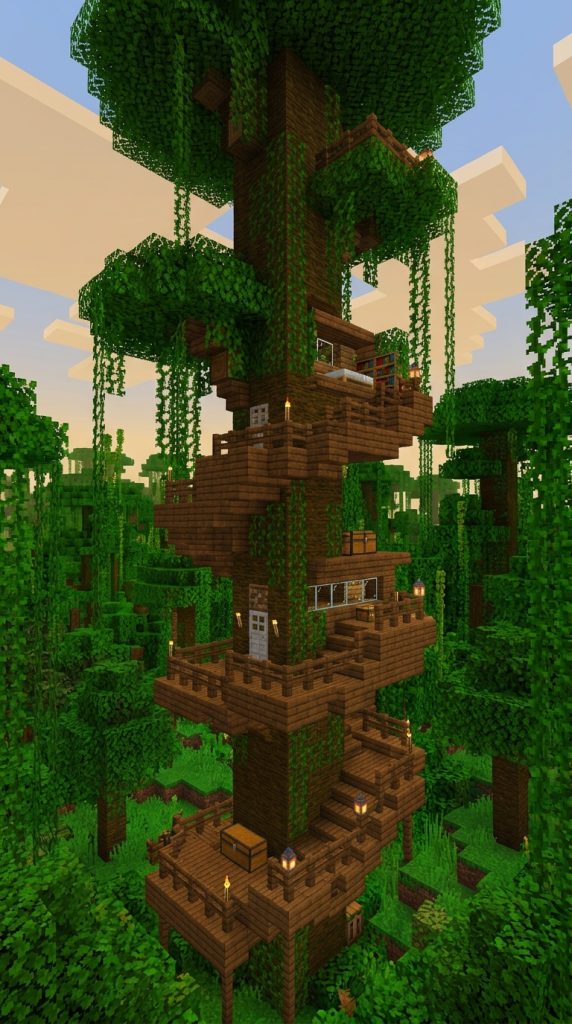
How to implement it (practical steps)
Find a tall, thick jungle tree (or combine multiple trees close together).
Start at the base with a small entrance room for storage or crafting.
Build a spiral staircase using jungle planks, slabs, or stairs that wraps upward around the trunk.
At different height levels, expand small platforms for specific purposes: bedroom, farm corner, enchantment space, or lookout point.
Use fences, leaves, and vines along edges to make the spiral feel naturally integrated instead of artificial.
Cap the top with a small viewing platform or canopy hut.
Best for
- Survival progression players
- Medium to large jungle trees
- Vertical-focused builders
- Compact yet functional bases
Pro tip
Don’t make the spiral perfectly uniform. Slight irregular spacing between levels makes it feel more organic and jungle-like.
Mistake to avoid
Avoid making the staircase too narrow or steep. If movement becomes annoying, the build becomes impractical no matter how good it looks.
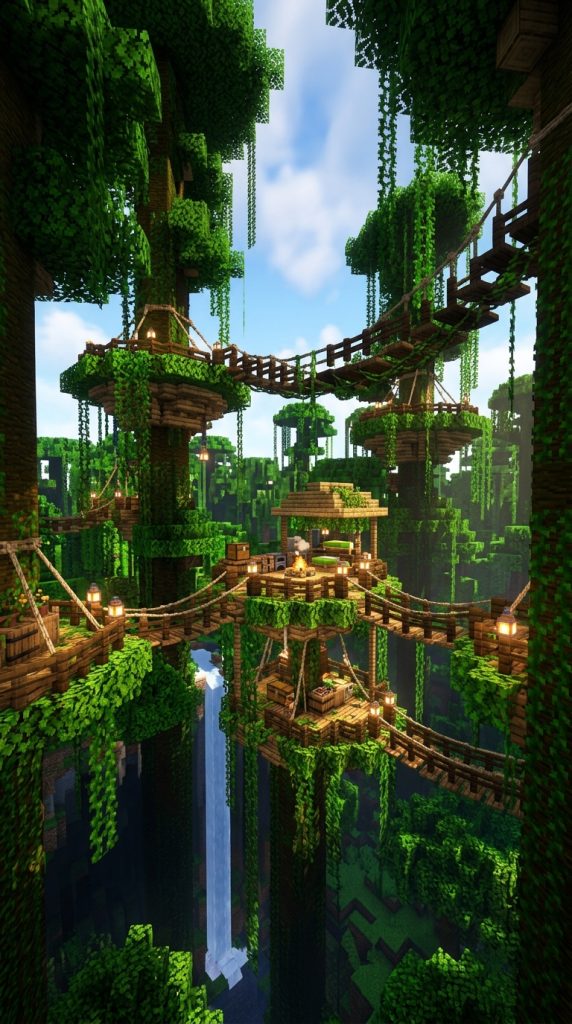
Idea 8: Jungle Hanging Net Platform Base (Suspended Survival Build)
What it is
The jungle hanging net platform base is a suspended build system that uses ropes, fences, and wooden platforms to create “floating” sections between trees. Instead of solid structures, the base feels lightweight and hanging in the canopy like a jungle canopy camp.
In modern Minecraft design, suspended builds are trending because they add realism to jungle survival—real explorers wouldn’t always build on solid ground; they’d use whatever the environment provides.
This design gives a sense of adventure, danger, and elevation all at once.
How to implement it (practical steps)
Identify 3–5 jungle trees close enough to connect.
Build small wooden platforms attached to each tree trunk using logs or fences as supports.
Connect platforms using “net-like” bridges made from fences, trapdoors, and slabs to simulate hanging walkways.
Keep each platform slightly different in height to create a layered canopy effect.
Add minimal furniture per platform (bed on one, storage on another, crafting area on another).
Decorate edges with vines and leaves to soften the structure and hide supports.
Best for
- Adventure-style survival worlds
- Large jungle canopies
- Players who like exploration bases
- Vertical mobility gameplay
Pro tip
Use uneven bridge tension visually—some tight, some slightly sagging—to make it feel like real hanging structures.
Mistake to avoid
Do not overfill platforms. If every platform has too many items, the airy “hanging” feeling is completely lost.
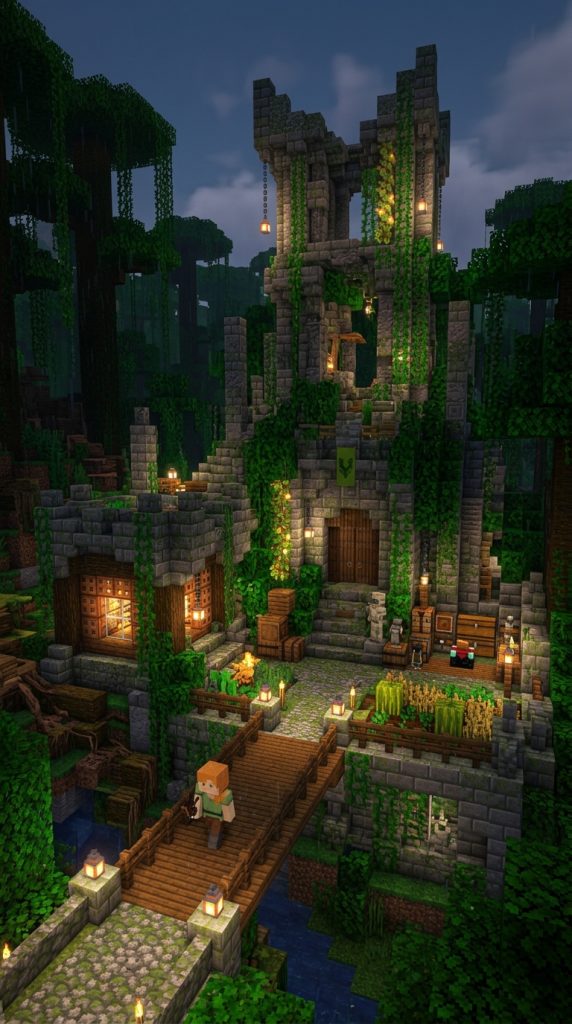
Idea 9: Jungle Ruins-Inspired Survival Base (Ancient Civilization Style)
What it is
The jungle ruins-inspired survival base is a build that looks like it was once an ancient structure reclaimed by the jungle. Instead of building a clean modern house, you intentionally design it to look partially destroyed, overgrown, and abandoned.
In 2026 aesthetic builds, “ruined jungle temples” and ancient civilization themes are extremely popular because they create storytelling without needing complex architecture. It feels like your base has history.
This style blends perfectly with Minecraft jungle temples and naturally generated structures.
How to implement it (practical steps)
Start with a partially complete structure using stone bricks, mossy stone, and jungle wood.
Break symmetry on purpose—missing walls, cracked pillars, uneven floors.
Add vines aggressively across walls, ceilings, and broken edges to show nature reclaiming the structure.
Incorporate jungle leaves and roots growing into the base from surrounding trees.
Inside, keep the space functional but minimal: bed, storage, crafting, and maybe enchantment area.
Add “ruin details” like broken pillars, collapsed roofs, and hidden entrances.
Best for
- Story-driven survival worlds
- Large jungle areas with ruins
- Players who enjoy immersive builds
- Aesthetic-focused creators
Pro tip
Less perfection = more realism. The more “unfinished” it looks, the more believable the jungle takeover effect becomes.
Mistake to avoid
Do not make it too clean or symmetrical. A perfect structure ruins the entire “ancient ruin” concept instantly.
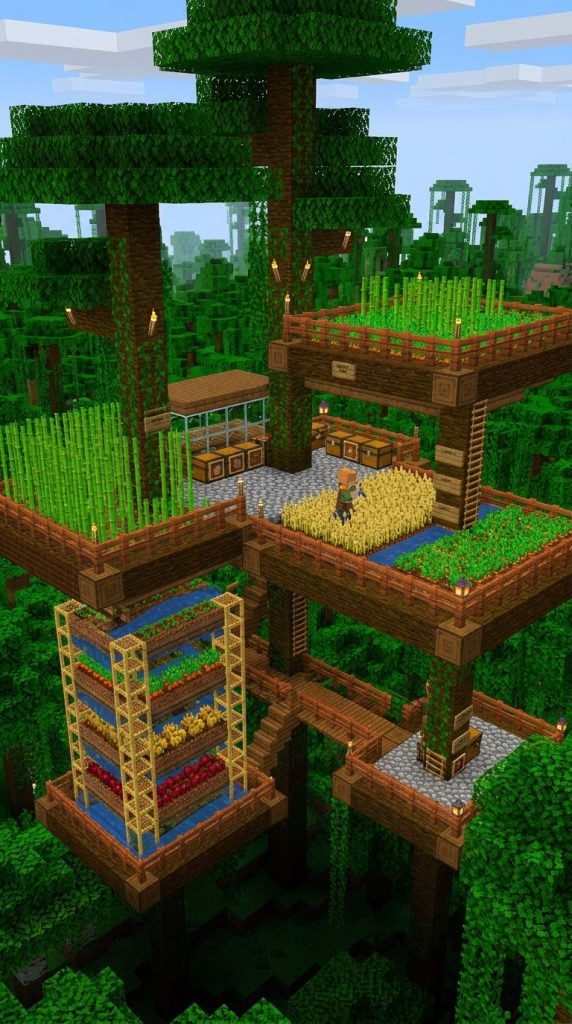
Idea 10: Jungle Farming Canopy Base (Hidden Food System Build)
What it is
The jungle farming canopy base is a layered farming system built inside and above the jungle trees instead of on flat ground. It uses the natural height of the jungle biome to create stacked farms for crops, sugarcane, bamboo, and even small animal pens in separate elevated sections.
In 2026 Minecraft survival design, vertical farming is becoming more important because it saves space and blends better with dense biomes. In jungles especially, ground space is uneven and crowded, so moving agriculture upward makes the base more efficient and more immersive.
This build turns your jungle house area into a self-sustaining ecosystem hidden in the canopy.
How to implement it (practical steps)
Start by selecting a cluster of jungle trees with enough spacing between trunks.
Build small wooden platforms at different heights (ground level, mid-canopy, upper canopy).
Assign each platform a purpose: one for wheat/carrot farming, one for bamboo/sugarcane, one for storage of food.
Use fences or trapdoors around farm edges to prevent falling and to keep structure organized.
Add water sources carefully in each farming section and hide them using slabs or leaves for a cleaner look.
Connect platforms using ladders, vines, or wooden stairs to maintain vertical movement.
Best for
- Survival players needing food sustainability
- Medium to large jungle biomes
- Vertical base enthusiasts
- Players who prefer hidden functional builds
Pro tip
Stack farms in layers instead of spreading them horizontally. Vertical efficiency is the key to jungle survival bases.
Mistake to avoid
Do not place all farms on one level. That defeats the purpose of canopy farming and wastes the biome’s vertical potential.
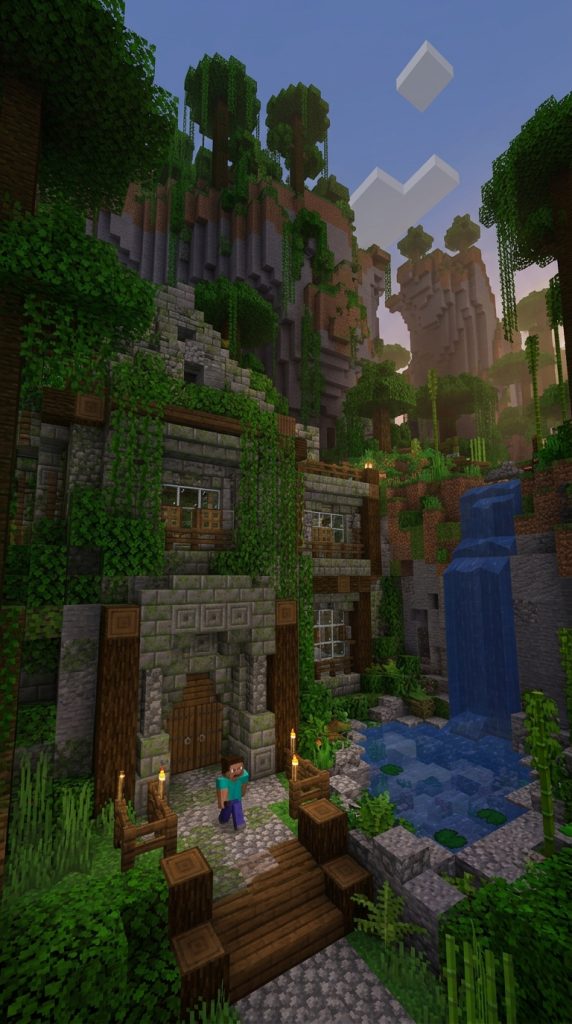
Idea 11: Jungle Cliff Temple Base (Stone + Nature Hybrid Build)
What it is
The jungle cliff temple base is a semi-structured build carved into or attached to a cliffside, combining stone temple architecture with jungle overgrowth. It looks like a forgotten jungle sanctuary where nature and ancient construction have merged over time.
In modern Minecraft aesthetics, hybrid builds (stone + natural biome blending) are extremely popular because they feel both man-made and naturally reclaimed. This makes the build feel like part of the world instead of something placed on top of it.
It works especially well in jungle biomes with hills, ravines, or exposed stone cliffs.
How to implement it (practical steps)
Find a cliff or steep jungle mountain with visible stone surfaces.
Carve out a central chamber inside the cliff or build a façade against it using stone bricks and mossy variants.
Add jungle wood supports and beams to contrast the stone structure.
Integrate vines heavily across stone walls to make the temple feel reclaimed by nature.
Create internal rooms: storage chamber, sleeping area, enchantment space, and a small ritual-style hall if desired.
Add a staircase or vine pathway leading up the cliff to the main entrance.
Best for
- Large jungle and mountain hybrid areas
- Advanced survival or creative builds
- Players who like cinematic structures
- Story-driven worlds
Pro tip
Blend materials gradually—don’t separate stone and jungle wood harshly. Mix mossy stone, cracked stone, and wood together for smoother transitions.
Mistake to avoid
Do not over-clean the structure. A jungle temple should feel aged, uneven, and partially reclaimed by nature—not polished or modern.
Idea 12: Jungle Canopy Village Network (Multi-House Connected System)
What it is
The jungle canopy village network is a full settlement system built across multiple trees and connected by bridges, ladders, and rope-like walkways. Instead of one base, you create several small homes spread across the jungle canopy, forming a living village in the trees.
In 2026 Minecraft building trends, distributed base systems are becoming more popular because they feel realistic for survival and create exploration-based gameplay. This design turns the jungle into a navigable living environment instead of a single build location.
It feels like a real treetop civilization hidden inside the biome.
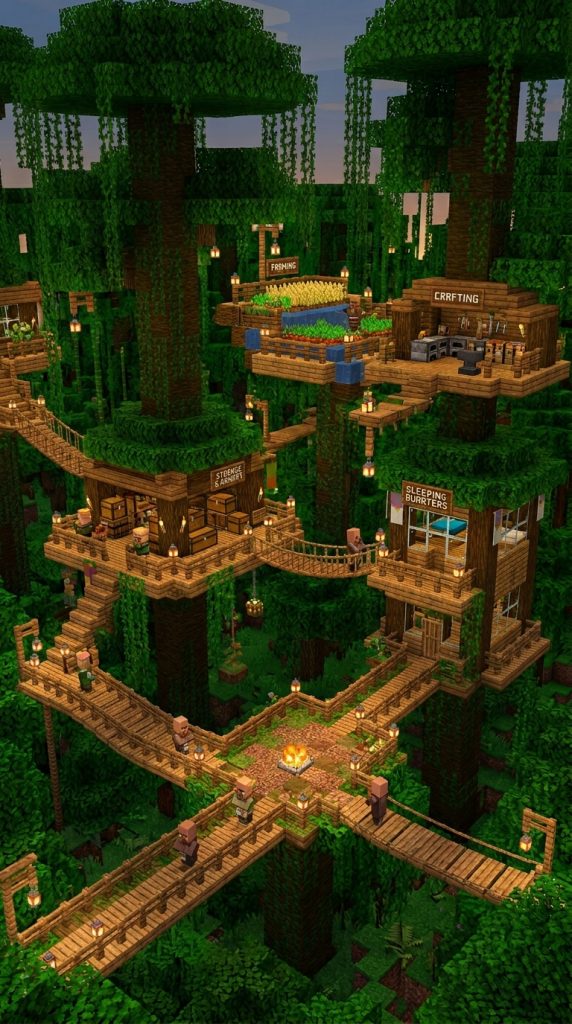
How to implement it (practical steps)
Select a large jungle area with many tall trees close together.
Assign each tree a role: one tree for sleeping quarters, one for storage, one for farming, one for crafting, one for lookout.
Build small platforms on each tree instead of large structures.
Connect all trees using wooden bridges, vines, or rope-style fencing paths.
Add lanterns or hidden lighting along pathways to make navigation easier at night.
Keep each tree slightly unique in design so it feels like separate homes within one village.
Best for
- Large jungle biomes
- Advanced survival players
- Exploration-focused gameplay
- Multiplayer or roleplay worlds
Pro tip
Think of each tree as a “house in a district.” Separation creates identity, but bridges keep it unified.
Mistake to avoid
Do not turn it into one giant connected floor. If everything feels like one platform, it stops being a village and becomes a single base.
Idea 13: Jungle Waterfall Secret Base (Hidden Survival Hideout)
What it is
The jungle waterfall secret base is a hidden survival build carved behind or inside a natural waterfall in the jungle biome. From the outside, it looks like normal terrain with flowing water and dense greenery. But behind that water curtain is a fully functional base.
In 2026 Minecraft survival design, hidden bases are trending again because players want immersion, security, and storytelling. This idea works perfectly in jungles because waterfalls naturally generate near cliffs, caves, and uneven terrain. You’re not forcing the environment—you’re using what already exists.
This is not just a house. It’s a concealment strategy disguised as a natural landscape feature.
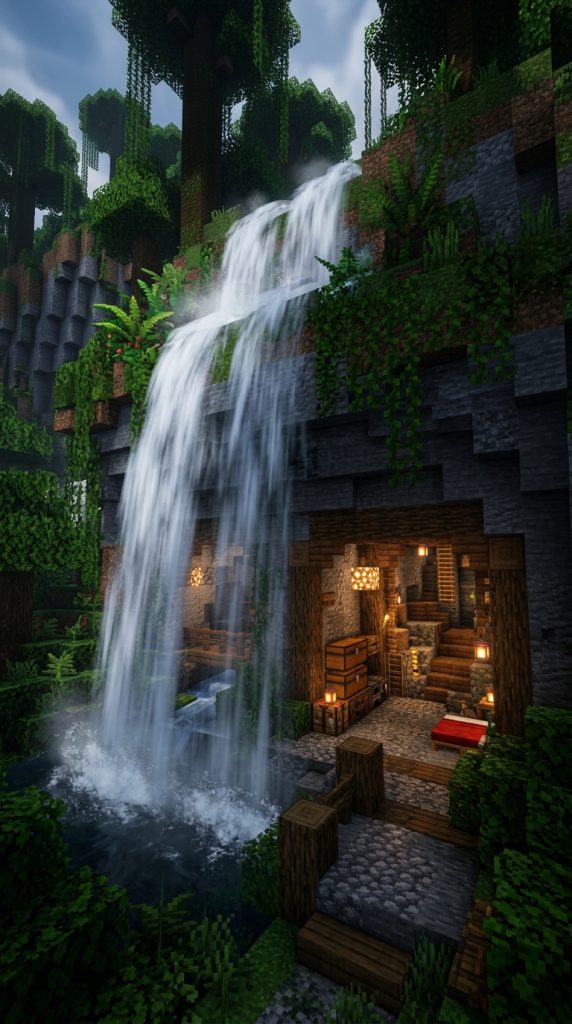
How to implement it (practical steps)
Find a jungle waterfall that flows over a cliff or into a small pool area. The best ones have a solid rock face behind them.
Carefully dig or carve a space directly behind the falling water. Keep the entrance aligned so the water acts like a curtain.
Build a compact survival base inside the hidden area. Focus on essentials: bed, storage, crafting, furnace, and maybe enchantment setup.
Use stone, mossy stone, and jungle wood inside to match the damp, natural environment of a waterfall cave.
Hide lighting sources behind blocks, leaves, or in corners so no direct glow is visible from outside.
Create a subtle entrance path—either through swimming behind water, a vine ladder, or a concealed tunnel.
Best for
- Solo survival worlds
- Players who prefer hidden or secure bases
- Medium jungle or cliff-heavy biomes
- Roleplay or adventure-style gameplay
Pro tip
Add a secondary emergency exit (like a hidden tunnel or vine escape route). If someone discovers the waterfall entrance, you still have a backup way out.
Mistake to avoid
Do not make the entrance too wide or obvious. If the waterfall doesn’t fully cover the base, the “secret” concept is immediately ruined and the build loses its purpose.