
A hallway is one of the most underestimated parts of a home, yet in reality, it is one of the most psychologically powerful spaces in interior design. It’s the transition zone between rooms, the first impression when someone enters your home, and the final visual memory before they leave a space. And still, most people treat it as nothing more than a passageway with a light bulb.
That mindset is exactly why so many homes feel incomplete—even when the main rooms are beautifully decorated.
Lighting is what decides whether a hallway feels ordinary or luxurious. Not furniture, not paint, not even flooring alone. Light controls how the space is perceived: wide or narrow, warm or cold, expensive or basic, intentional or accidental. A poorly lit hallway flattens everything. It removes depth, hides architectural potential, and makes even a well-designed home feel disconnected. On the other hand, thoughtfully designed lighting can turn a simple corridor into a cinematic experience of movement and atmosphere.

The biggest mistake people make is assuming hallway lighting is only about visibility. That’s the most basic function, but luxury design never stops at basic function. In high-end interiors, lighting is treated as a storytelling tool. It doesn’t just help you see where you are going—it guides how you feel while moving through the space. It creates rhythm, highlights structure, and builds emotional continuity between rooms.
When you walk through a well-lit luxury hallway, you don’t just notice brightness—you notice flow. The light subtly leads you forward. It draws attention to textures on the wall, softens transitions between doors, and creates a sense of direction without being obvious. This is what separates a standard hallway from a designed one. It feels intentional, even when it’s minimal.
Another major issue in most homes is over-reliance on a single overhead light. A central ceiling bulb may illuminate the space, but it destroys atmosphere. It creates harsh shadows, flattens architectural detail, and makes the hallway feel like a utility space rather than part of the home’s design identity. Luxury interiors avoid this by layering light sources instead of depending on one point of brightness.
Layered lighting is the core principle behind high-end hallway design. Instead of one light doing everything, different types of lighting handle different roles. Ambient lighting provides overall softness. Accent lighting highlights walls, artwork, or textures. Indirect lighting—such as hidden LEDs or wall washes—adds depth and glow without exposing the source. When these layers work together, the hallway stops feeling flat and starts feeling dimensional.
But lighting alone is not enough without placement strategy. Even expensive fixtures can look cheap if they are placed incorrectly. Luxury hallway lighting is often spaced rhythmically, not randomly. Repeated wall sconces, evenly placed recessed lights, or continuous light strips create a visual pattern that the eye naturally follows. This rhythm is what makes long hallways feel structured instead of endless.
Material interaction is another detail most people ignore. Light behaves differently depending on what it hits. A textured wall, a matte finish, a mirror, or wood paneling will all reflect light in unique ways. Luxury designers intentionally pair lighting with materials so the light becomes part of the surface experience. This is why a simple warm light can feel incredibly expensive when it grazes a textured wall or softly reflects off a wood grain panel.
There is also a shift in modern luxury toward indirect and diffused lighting instead of harsh direct sources. Instead of exposing bulbs, designers hide light within ceiling coves, behind wall panels, or under architectural edges. This creates a soft glow effect rather than a visible fixture. The result is more atmospheric, more calming, and far more refined. It removes visual clutter and replaces it with mood.
Another important aspect is proportion. Hallways are usually narrow or elongated, which makes lighting choices even more critical. If lighting is too concentrated, the space feels heavy. If it’s too sparse, it feels empty. The goal is balance—enough illumination to feel safe and functional, but enough softness and variation to feel designed. Luxury lighting always respects proportion rather than overpowering it.
Color temperature also plays a major role. Harsh white lighting can make even expensive interiors feel cold and uninviting. Warm lighting, on the other hand, creates depth, softness, and comfort. In luxury hallways, warm tones are often preferred because they make transitions between rooms feel natural instead of abrupt. It creates a consistent emotional tone throughout the home.
Ultimately, hallway lighting is not just a design choice—it’s a spatial experience. It controls how people move, what they notice, and how they emotionally connect different parts of a home. A well-lit hallway doesn’t demand attention, but it quietly elevates everything around it. It makes the entire house feel more cohesive, more intentional, and more expensive without needing dramatic decor.
In this guide, you’ll explore 9 luxury hallway lighting inspiration ideas that focus on real design principles used in modern high-end interiors. These are not just decorative suggestions—they are functional lighting strategies that improve depth, mood, and architectural flow.
Because in luxury design, the hallway is never just a connector.
It’s part of the experience.
1. Recessed Ceiling Strip Lighting (Hidden Glow Minimal Luxury)
This is one of the most important foundations of modern luxury hallway design. Instead of visible fixtures dominating the space, the light itself becomes invisible and only the glow is visible. That shift is what instantly upgrades a hallway from basic to architectural.
What it is
A lighting setup where LED strip lights are hidden inside ceiling grooves, coves, or false ceiling edges. The light bounces softly downward or along the ceiling line, creating a continuous glowing effect instead of harsh points of light.
It makes the hallway feel wider, taller, and more expensive without adding any visible decor.
How to implement it (practical steps)
This works best during renovation or false ceiling design.
- Create a recessed groove along the ceiling edges or center channel
- Install warm white LED strip lights inside the channel
- Diffuse the light using a frosted cover to avoid sharp lines
- Keep brightness medium—not too strong, not too dim
- Run lighting in a continuous line for flow (avoid gaps)
- Pair with neutral wall colors for soft reflection
If your hallway is narrow, run strips along both sides for expansion effect.
If your hallway is long, use a central cove line to guide movement.
Best for
- Modern minimalist interiors
- Long or narrow hallways
- New builds or renovation projects
- Luxury apartment styling
This works best when you want a clean, architectural glow instead of visible fixtures.
Pro tip
Use 2700K–3000K warm lighting for a soft hotel-like atmosphere.
Mistake to avoid
Don’t use harsh cool white LEDs—it destroys the luxury warmth and feels commercial.
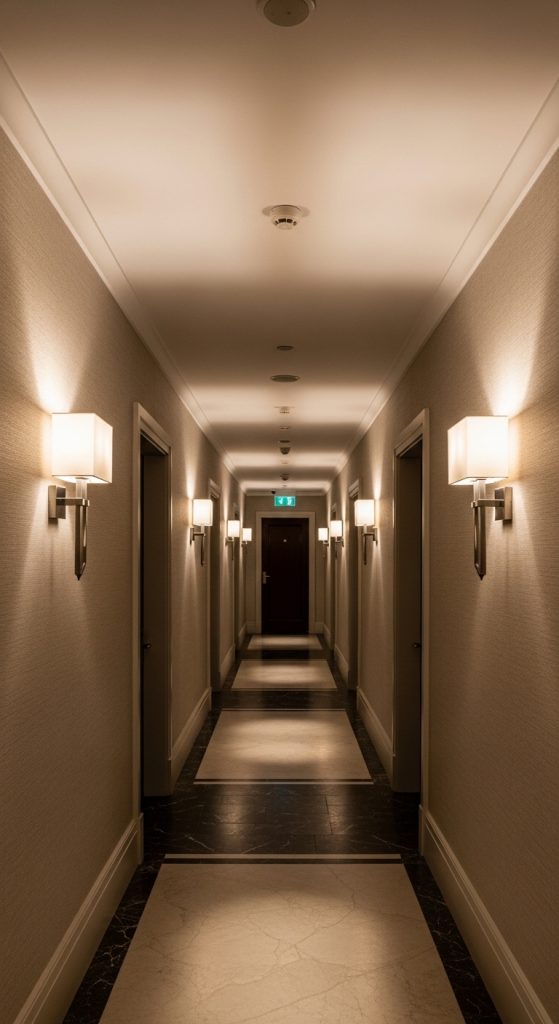
2. Wall Sconce Rhythm Lighting (Hotel Corridor Effect)
This is the most recognizable luxury hallway lighting style used in hotels and high-end homes. The key is repetition and spacing. Instead of random lighting, you create a rhythm that guides the eye forward.
What it is
A series of wall-mounted sconces placed at equal intervals along the hallway walls. These lights create soft pools of illumination and shadow, adding depth and structure to the corridor.
It turns a plain hallway into a designed visual sequence.
How to implement it (practical steps)
This requires planning wall spacing carefully.
- Choose identical or matching wall sconces for consistency
- Install them at equal distances along the hallway (usually 6–8 feet apart)
- Mount at eye-level height for balanced glow
- Use warm diffused bulbs instead of exposed bright lights
- Align placement perfectly for symmetry and rhythm
- Pair with neutral or textured walls for light interaction
If your hallway is short, use fewer sconces but maintain symmetry.
If your hallway is long, maintain consistent spacing to avoid visual breaks.
Best for
- Long corridors
- Luxury hotel-style homes
- Classic or modern interiors
- Hallways with plain walls needing depth
This works best when you want structured elegance instead of flat lighting.
Pro tip
Use sconces that cast both upward and downward light for layered wall effects.
Mistake to avoid
Don’t mix different sconce styles. It breaks rhythm and makes the hallway look inconsistent.
3. Floor-Level LED Path Lighting (Soft Guiding Glow)
This is a subtle but extremely powerful luxury technique. Instead of lighting from above, the glow comes from the lower part of the hallway, guiding movement like a soft visual path.
What it is
LED lighting installed near the baseboards, skirting, or floor edges that creates a gentle glow along the walking path. It highlights the structure of the hallway while improving safety and atmosphere at night.
It feels modern, futuristic, and very high-end when done correctly.

How to implement it (practical steps)
This is usually done during flooring or wall finishing.
- Install LED strip lights along baseboard edges or recessed floor channels
- Use frosted covers to diffuse harsh light
- Keep lighting continuous along the hallway path
- Use warm white tone for comfort and elegance
- Combine with minimal ceiling lighting for balance
- Ensure wiring is hidden for clean finish
If your hallway is dark, combine with ceiling ambient lighting.
If your hallway is already bright, use dimmer floor lighting for mood.
Best for
- Modern luxury homes
- Night-time ambiance lighting
- Minimalist interiors
- Long straight hallways
This works best when you want subtle guidance and cinematic atmosphere.
Pro tip
Install dimmers so you can control intensity based on time of day.
Mistake to avoid
Don’t make floor lighting too bright—it should guide, not dominate the space.
4. Pendant Drop Lighting in Hallway (Statement Luxury Focal Points)
This is the kind of lighting that immediately signals “designed space” instead of “basic corridor.” Pendant lights in a hallway create vertical interest, which is something most hallways completely lack. Without vertical variation, hallways feel flat and tunnel-like.
What it is
A series of hanging pendant lights installed along the hallway ceiling, either in a linear arrangement or staggered formation. These lights drop down slightly into the space, creating visual rhythm and a sense of architectural layering.
Instead of light being only on the ceiling or walls, it enters the “air space” of the hallway.

How to implement it (practical steps)
This requires careful height control and spacing.
- Choose slim, elegant pendant designs (glass, metal, or matte finishes)
- Maintain equal spacing between each pendant for rhythm
- Keep hanging height consistent—avoid blocking walking space
- Use warm diffused bulbs to avoid harsh glare
- Align pendants in a straight line for modern symmetry
- Pair with neutral ceiling and wall tones for contrast focus
If your ceiling is low, choose shorter pendant drops.
If your hallway is wide, you can use slightly larger fixtures for balance.
Best for
- High-ceiling hallways
- Luxury modern or contemporary homes
- Entry corridors and long passages
- Homes needing visual focal points
This works best when you want your hallway to feel like a designed interior moment, not just a passage.
Pro tip
Use identical pendant styles but vary the glass opacity slightly for subtle depth.
Mistake to avoid
Don’t hang pendants too low—this disrupts movement and makes the hallway feel cramped.
5. Mirror-Backed Hallway Lighting (Light Amplification Luxury Trick)
This is a high-end interior designer technique used to double both light and visual space. Mirrors are not just decorative—they actively change how lighting behaves in a hallway. When combined with lighting, they create depth illusions and brightness without adding extra fixtures.
What it is
Wall mirrors placed strategically along a hallway with integrated or nearby lighting (sconces, LED strips, or ceiling lights). The mirrors reflect light, making the hallway appear wider, brighter, and more open.
It creates the illusion of extended space and layered depth.

How to implement it (practical steps)
This is about placement, not just decoration.
- Install large vertical or panel mirrors along one side of the hallway
- Place wall sconces or lighting opposite the mirrors for reflection
- Ensure lighting is soft to avoid harsh glare reflection
- Keep mirror frames minimal for modern luxury look
- Maintain equal spacing if using multiple mirror panels
- Avoid clutter near mirrors for clean reflection effect
If your hallway is narrow, mirrors visually widen it instantly.
If your hallway is dark, mirrors multiply available light naturally.
Best for
- Small or narrow hallways
- Modern luxury apartments
- Entryways needing expansion effect
- Low-light interiors
This works best when you want a space to feel twice as large without structural changes.
Pro tip
Use slightly tinted or bronze mirrors for warmer, more expensive-looking reflections.
Mistake to avoid
Don’t place mirrors opposite messy or cluttered areas—they will amplify visual chaos instead of elegance.
6. Cove Lighting with Wall Wash Effect (Soft Architectural Glow)
This is one of the most refined luxury lighting techniques because it removes all visible sources of light and replaces them with pure ambiance. Instead of seeing fixtures, you only see illuminated surfaces. It’s subtle, but extremely powerful in creating mood.
What it is
Hidden LED lighting installed in ceiling coves or upper wall recesses that directs light downward or across walls. This creates a “washed” glow effect, where walls appear softly illuminated without visible bulbs.
It adds depth, softness, and architectural drama.
How to implement it (practical steps)
This works best with planned ceiling or wall recesses.
- Create a recessed ceiling edge or upper wall channel
- Install concealed LED strip lighting inside the groove
- Direct light toward walls for washing effect
- Use warm white lighting for soft ambiance
- Ensure even distribution—no patchy brightness
- Combine with minimal central lighting if needed
If your hallway has textured walls, this effect becomes even more dramatic.
If your hallway is plain, it adds instant dimension.
Best for
- Modern luxury homes
- Minimalist interiors
- Long corridors needing softness
- High-end architectural designs
This works best when you want a calm, expensive atmosphere without visible fixtures.
Pro tip
Use matte wall finishes so the light diffuses softly instead of reflecting harshly.
Mistake to avoid
Don’t install overly bright LED strips—cove lighting should glow, not shine aggressively.
7. Linear Track Lighting for Modern Hallway Flow (Directional Luxury Lighting)
This is one of the most practical yet high-end looking hallway lighting systems when done properly. Unlike fixed ceiling lights, track lighting gives control. It lets you direct light where you want it, which is exactly how modern luxury interiors work—intentional, not random.
What it is
A ceiling-mounted track system with adjustable light heads placed along a straight line. These lights can be angled toward walls, artwork, or walking paths to create structured illumination throughout the hallway.
Instead of one fixed glow, you get directional layers of light.

How to implement it (practical steps)
This is both functional and design-focused.
- Install a straight track line along the center or side of the ceiling
- Choose slim, matte-finish track fixtures for modern aesthetics
- Space light heads evenly for visual rhythm
- Angle some lights toward walls and some toward the floor
- Use warm white bulbs for luxury ambiance
- Keep the design minimal—avoid bulky industrial tracks
If your hallway is long, extend the track continuously for flow.
If your hallway has artwork, aim lights directly at those areas.
Best for
- Modern and industrial luxury homes
- Hallways with artwork or decor walls
- Flexible lighting needs
- Long corridors requiring direction
This works best when you want adjustable luxury lighting that can evolve with your space.
Pro tip
Mix beam angles (narrow + wide) for layered lighting depth.
Mistake to avoid
Don’t overuse too many spotlights—it creates visual clutter instead of elegance.
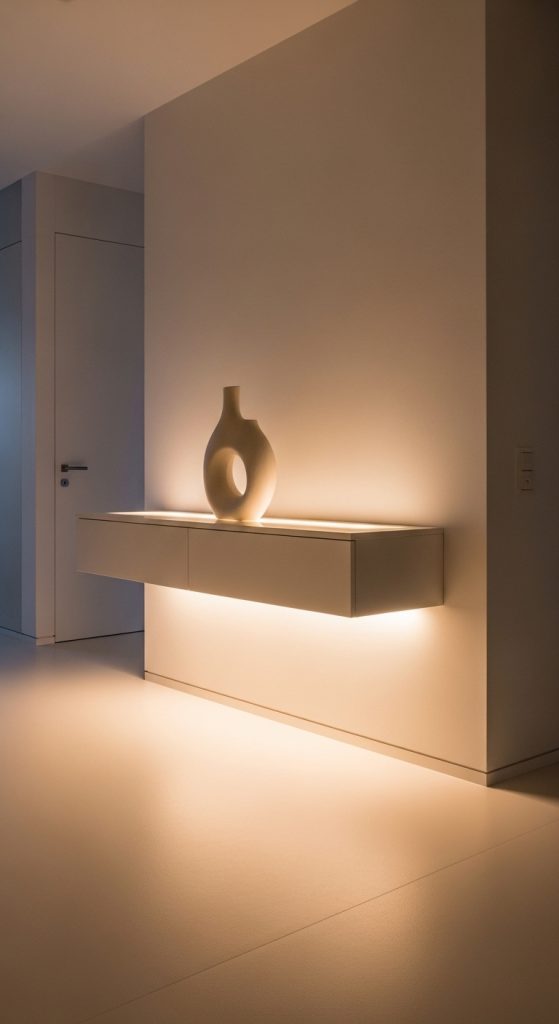
8. Hidden Under-Console Lighting (Floating Furniture Glow Effect)
This is a subtle but extremely premium-looking lighting idea that creates the illusion of floating furniture. It’s commonly used in luxury hotels and high-end interiors to add depth without adding visual noise.
What it is
LED lighting installed underneath hallway consoles, shelves, or narrow tables so the furniture appears slightly lifted from the floor. The soft glow beneath creates a floating effect and adds depth to the floor plane.
It makes even simple furniture look custom-designed.
How to implement it (practical steps)
This works best with minimal furniture setups.
- Choose a slim hallway console or floating shelf
- Install LED strip lights underneath the base or mounting area
- Hide wiring completely for a clean finish
- Use warm or neutral white lighting for softness
- Keep brightness low to avoid harsh floor glare
- Pair with simple decor like vases or minimal objects
If your hallway is narrow, keep furniture minimal and lighting subtle.
If your hallway is wide, extend lighting under multiple pieces.
Best for
- Modern luxury interiors
- Entry hallways
- Narrow corridors with furniture
- Minimalist home designs
This works best when you want furniture to feel integrated into architecture.
Pro tip
Use dimmable LEDs so you can switch between soft ambiance and brighter utility lighting.
Mistake to avoid
Don’t use bright blue-white LEDs—they destroy the warm floating illusion.
9. Sculptural Statement Wall Lighting (Art + Illumination Fusion)
This is the most artistic and visually impactful hallway lighting idea. Instead of hiding lights or spacing them evenly, this approach treats lighting as sculpture. It becomes part of the wall design itself.
What it is
Decorative wall lighting fixtures that act as both lighting and art pieces. These can be geometric sconces, abstract metal designs, or layered light sculptures that cast patterned shadows and glow across the hallway walls.
It transforms the hallway into a gallery-like space.

How to implement it (practical steps)
This requires careful selection and placement.
- Choose sculptural or artistic wall light fixtures
- Install them at eye level for visual impact
- Space them strategically—not too close together
- Use warm diffused light to enhance shadows and depth
- Keep surrounding wall design minimal so lighting stands out
- Align fixtures with hallway flow or focal points
If your hallway is simple, sculptural lighting becomes the main design feature.
If your hallway already has texture, keep fixture design more minimal.
Best for
- Luxury and designer interiors
- Hallways that need visual identity
- Modern artistic homes
- Statement entry corridors
This works best when you want lighting to double as decor.
Pro tip
Choose fixtures that cast interesting shadows—this adds depth even when lights are on.
Mistake to avoid
Don’t mix multiple competing sculpture styles. One strong design language is enough.